
The ICSI procedure
After egg retrieval, mature oocytes are denuded of cumulus cells. A single morphologically normal sperm is immobilised and aspirated into a fine micro-injection needle, then injected directly into the ooplasm. Fertilisation is assessed 16-18 hours later.
When ICSI is needed
- Severe oligospermia (count below 5 million/ml)
- Severe asthenospermia (motility below 20 percent)
- Severe teratospermia (normal forms below 4 percent)
- Previous failed fertilisation with conventional IVF
- Surgically retrieved sperm (TESA, PESA, micro-TESE)
- Frozen-thawed sperm with limited yield
Fertilisation and pregnancy rates
ICSI achieves fertilisation rates of 70-80 percent per injected mature oocyte. Pregnancy and live birth rates per cycle depend primarily on female age and embryo quality, not on the use of ICSI itself.
ICSI — how it works
| Step | Detail |
|---|---|
| Sperm selection | A single healthy sperm |
| Injection | Directly into the egg |
| Best for | Male factor or prior failed fertilisation |
Our IVF practice follows international reproductive-medicine standards.
Frequently asked
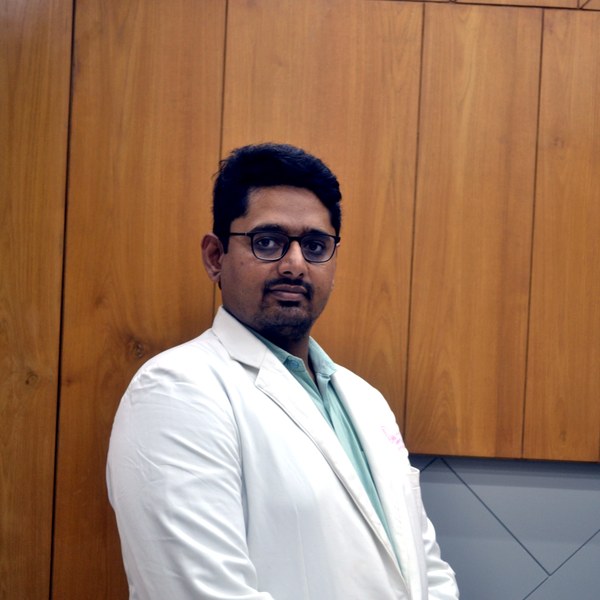
Dr Patel leads fertility care at Balaji Horizon, integrating reproductive surgery and IVF into a single plan — ethical, evidence-based and individualised, with realistic expectations and no overpromising of success.

Individualised IVF and fertility planning with honest, evidence-based counselling — and realistic expectations from the very first consultation.
ICSI — when it is needed, and when it is not
ICSI (intracytoplasmic sperm injection) places a single sperm directly into each egg. It is the treatment of choice for significant male-factor infertility and after previous fertilisation failure — but it is not automatically better than standard IVF for everyone.
Clear indications
ICSI is genuinely needed for low sperm count or motility, poor morphology, surgically retrieved sperm (TESA/PESA), or when conventional IVF has previously failed to fertilise. In these situations it meaningfully improves the chance of fertilisation.
When standard IVF is equally good
Where sperm parameters are normal, ICSI does not improve live-birth rates over conventional IVF and adds an unnecessary lab step. We do not apply ICSI reflexively to every cycle — we use it where there is a reason.
Safety and honesty
ICSI is well-established and safe in experienced hands; fertilisation is not guaranteed and depends on egg and sperm quality. We explain your expected fertilisation outcome individually and never present ICSI as a way to overcome problems it cannot solve.
Dr. Priyadatt Patel
Senior Gynecologist · Advanced Laparoscopic Surgeon · IVF and Endometriosis Programme Lead
MS OBGyn · Pregnancy Care · Advanced Gynaecological Ultrasound · Fertility Preservation
ESHRE / ESGE / AAGL / ASRM guideline-aligned practice. 3D Karl Storz precision technique. Fertility-preservation-first philosophy. Evidence-based decisions, honest counselling, long-term outcomes orientation.
Science City Road, Ahmedabad 380060
Mon–Sat 11:00–20:00 · +91 97234 31544
Naranpura, Ahmedabad
Mon–Sat 08:30–10:30 · +91 70460 02566