
First Trimester Screening • 11–13+6 Weeks
NT Scan & First Trimester Chromosomal Screening
Accurate nuchal translucency measurement and Down syndrome risk assessment — performed at 11–13+6 weeks with GE Voluson technology by an ISUOG-trained specialist. Ahmedabad.
What Is the NT Scan — and Why Is It Critical?
The Nuchal Translucency (NT) scan is a first trimester screening examination performed between 11 weeks and 13 weeks + 6 days of gestation. It is the most important screening window in the entire pregnancy — the results of this scan guide whether further diagnostic testing (amniocentesis, NIPT) is required.
What the scan measures and assesses:
- Nuchal translucency (NT) — fluid at the back of the fetal neck (normal: <3.5 mm; measured to 0.1 mm precision)
- Nasal bone — absent nasal bone is a recognised soft marker for Down syndrome
- Ductus venosus flow — abnormal waveform associated with cardiac defects and chromosomal conditions
- Crown-rump length (CRL) — confirms gestational age for accurate screening calculations
- Early fetal anatomy — brain, spine, limbs, abdominal wall, bladder at 11–13+6 weeks
- Uterus and ovaries — structural assessment and adnexal evaluation
Chromosomal and Structural Conditions Screened
| Condition | Chromosomes | NT Association | Additional Markers |
|---|---|---|---|
| Down syndrome | Trisomy 21 | Increased NT | Absent nasal bone, abnormal ductus venosus |
| Edwards syndrome | Trisomy 18 | Increased NT | Structural defects, choroid plexus cysts |
| Patau syndrome | Trisomy 13 | Increased NT | Cardiac + brain anomalies |
| Turner syndrome | 45,X | Large cystic hygroma | Hydrops, cardiac defects |
| Congenital heart disease | — | NT >3.5 mm | Abnormal ductus venosus, tricuspid regurgitation |
Double Marker Test — PAPP-A and Free β-hCG
The double marker test measures two placental biochemical markers in maternal blood: Pregnancy-Associated Plasma Protein-A (PAPP-A) and free beta-human Chorionic Gonadotropin (free β-hCG). Performed at 10–13+6 weeks — ideally at the same visit as the NT scan — it provides quantitative chromosomal risk stratification that ultrasound alone cannot deliver.
Each marker is expressed as a Multiple of the Median (MoM) — the ratio of the measured value to the expected median for a normal pregnancy at the same gestational age. A MoM near 1.0 is normal. Significant deviation, interpreted alongside NT measurement, maternal age, and crown-rump length, recalibrates the background chromosomal risk to a precise individual probability.

PAPP-A (Pregnancy-Associated Plasma Protein-A)
A glycoprotein produced by the placenta. PAPP-A levels rise progressively in normal pregnancy. In the first trimester, abnormally low PAPP-A (↓ MoM) is one of the most consistent and early biochemical signals for chromosomal abnormalities — appearing before the NT measurement can fully discriminate risk.
- Trisomy 21 (Down syndrome): ↓ ~0.5 MoM
- Trisomy 18 (Edwards syndrome): ↓↓ ~0.2 MoM
- Trisomy 13 (Patau syndrome): ↓↓ ~0.2 MoM
- Normal range: 0.5–2.0 MoM
Low PAPP-A also predicts placenta-related complications (growth restriction, pre-eclampsia) even when chromosomes are normal — adding independent clinical surveillance value.
Free β-hCG (Free Beta Human Chorionic Gonadotropin)
The free subunit of hCG, secreted by syncytiotrophoblast cells. In Down syndrome, free β-hCG is characteristically elevated (↑ MoM). In Trisomy 18 it is markedly reduced — creating an opposing pattern to Trisomy 21 that significantly improves discrimination.
- Trisomy 21 (Down syndrome): ↑ ~2.0 MoM
- Trisomy 18 (Edwards syndrome): ↓↓ ~0.2 MoM
- Trisomy 13 (Patau syndrome): ~1.0 MoM (near normal)
- Turner syndrome (45,X): ↑ ~2.0 MoM
- Normal range: 0.5–2.0 MoM
The opposing pattern in T21 (↓ PAPP-A + ↑ β-hCG) is the biochemical signature of Down syndrome in the first trimester and is the foundation of the FMF risk algorithm.
Biochemical MoM Profile by Chromosomal Condition
| Condition | PAPP-A MoM | Free β-hCG MoM | Biochemical Pattern | Combined with NT |
|---|---|---|---|---|
| Normal pregnancy | ~1.0 | ~1.0 | Both within normal range | Low background risk |
| Trisomy 21 (Down syndrome) | ↓ ~0.5 MoM | ↑ ~2.0 MoM | Low PAPP-A + elevated β-hCG (opposing/divergent pattern) | ↑ NT ≥3.5 mm + absent nasal bone in subset |
| Trisomy 18 (Edwards syndrome) | ↓↓ ~0.2 MoM | ↓↓ ~0.2 MoM | Both severely and concordantly reduced | ↑ NT + structural defects (cardiac, limb) |
| Trisomy 13 (Patau syndrome) | ↓↓ ~0.2 MoM | ~1.0 MoM | Very low PAPP-A, near-normal β-hCG | ↑ NT + brain + cardiac anomalies |
| Turner syndrome (45,X) | ~1.0 MoM | ↑ ~2.0 MoM | Normal PAPP-A, elevated β-hCG | Large cystic hygroma; hydrops |
| Triploidy (69,XXX/XYY) | ↓↓ very low | Variable (often ↑ in diandric triploidy) | Markedly reduced PAPP-A; β-hCG depends on type | Abnormal NT + early structural |
Combined First Trimester Screening (FTS) — The Evidence-Based Standard
When NT measurement is integrated with PAPP-A, free β-hCG, and maternal age using the Fetal Medicine Foundation (FMF) algorithm, the detection rate for Trisomy 21 reaches 90–95% at a 5% false positive rate — substantially superior to either biochemistry or NT alone (Malone et al., FASTER trial, NEJM 2005).
Addition of sonographic soft markers — nasal bone, ductus venosus pulsatility index, tricuspid regurgitation — can further elevate detection to 96–97% at a reduced 3% FPR, representing the most sensitive non-invasive first trimester screening possible (Nicolaides KH, Prenat Diagn 2011).
T21 Detection Rates — First Trimester Screening
At 5% FPR unless stated. Source: Nicolaides 2011; FASTER trial 2005; ISUOG 2023
When and How Is the NT Scan Performed?
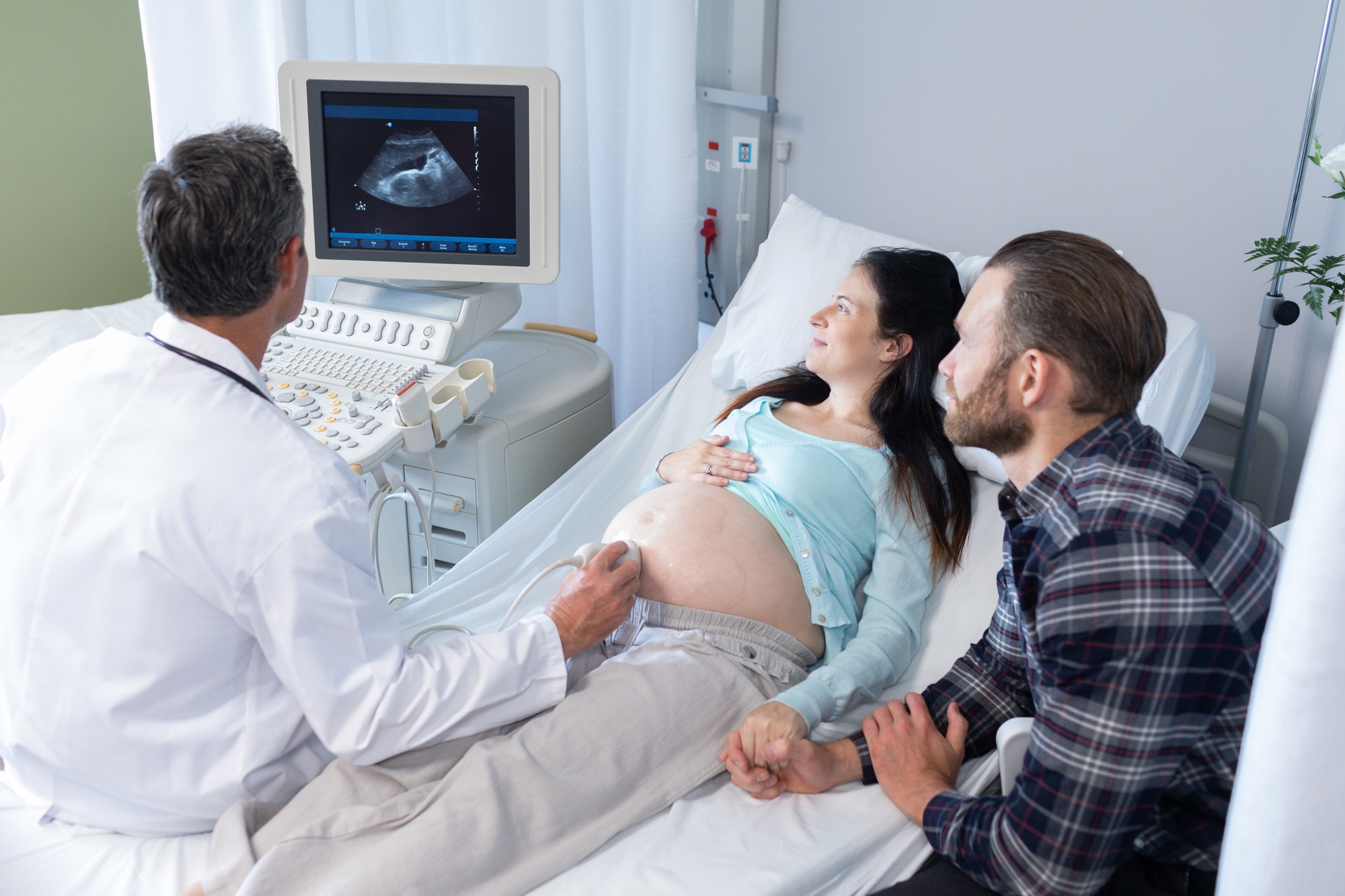
Optimal window: 11 weeks 0 days — 13 weeks 6 days (CRL 45–84 mm). Before 11 weeks the NT is too small to measure accurately. After 13+6 weeks the fluid reabsorbs and the screening window closes permanently — it cannot be replicated later in pregnancy.
ISUOG measurement criteria:
- Fetal position: neutral (not hyperflexed or hyperextended)
- Magnification: fetal head and thorax to fill the screen
- Measurement: inner edge to inner edge of the nuchal membrane
- Minimum 3 measurements taken — largest technically satisfactory measurement used
- Amnion must be distinguished from the nuchal membrane
| Parameter | Details |
|---|---|
| Gestational window | 11+0 to 13+6 weeks (CRL 45–84 mm) |
| Duration | 30–40 minutes |
| Preparation | Moderately full bladder; transvaginal route used if transabdominal view is suboptimal |
| Report | Provided same day with individual risk calculation; combined test requires blood results |
| Follow-up | High-risk result: counselling + NIPT or amniocentesis discussion |
NT Scanning at Balaji Horizon
- ISUOG measurement standards: Every NT scan is performed to full ISUOG technical criteria — magnification, caliper placement, neutral fetal position, minimum 3 measurements. This matters: NT measurement errors of 0.5 mm can significantly alter risk calculations.
- Dr. Mayank Chaudhary: Trained to ISUOG fetal medicine standards. All NT scans are performed and reported by an experienced specialist — not delegated to a technician.
- GE Voluson technology: The Voluson S10 Expert XD provides the image resolution and precision necessary for technically accurate NT caliper placement. Image quality directly affects measurement accuracy and therefore risk calculation.
- Same-day reporting: Written report with NT measurement, nasal bone status, and individual risk calculation provided at your appointment.
- Clear counselling: All results — normal and increased — are explained. Further testing options (NIPT, amniocentesis, detailed scan) are discussed in full. You will understand your result and your options before leaving.
- Two Ahmedabad locations: Science City (GE Voluson S10 Expert XD + SWIFT Plus) and Naranpura AEC (GE Voluson P6).
NIPT — Non-Invasive Prenatal Testing
Non-Invasive Prenatal Testing (NIPT) analyses cell-free fetal DNA (cffDNA) circulating in maternal blood. It can be performed from as early as 10 weeks of gestation — typically offered alongside the NT scan at 11–13 weeks. NIPT provides high-sensitivity chromosomal risk data with no procedural risk to the pregnancy, making it an important adjunct to first trimester ultrasound assessment.
What NIPT Screens For — Detection Rates
| Condition | What It Means | NIPT Detection Rate | False Positive Rate |
|---|---|---|---|
| Trisomy 21 (Down syndrome) | Extra chromosome 21 — most common live-born trisomy | >99% | <0.1% |
| Trisomy 18 (Edwards syndrome) | Extra chromosome 18 — associated with severe structural defects | 97–99% | <0.1% |
| Trisomy 13 (Patau syndrome) | Extra chromosome 13 — associated with multiple organ anomalies | 87–99% | <0.1% |
| Sex Chromosome Aneuploidies | Turner (45,X), Klinefelter (47,XXY), 47,XXX, 47,XYY | 88–95% | 0.1–0.5% |
| Microdeletions (expanded panels) | 22q11.2 (DiGeorge), 1p36, 5p– (Cri du Chat) — panel-dependent | 75–95% (variable) | Higher — interpret carefully |
Who Should Consider NIPT?
NT ≥3.5 mm or combined test risk >1:150 — NIPT or invasive testing recommended
Age-related aneuploidy risk increases progressively — NIPT offers high sensitivity without procedural risk
Prior trisomy — elevated recurrence risk makes NIPT appropriate in subsequent pregnancies
Echogenic focus, choroid plexus cysts, mild pyelectasis — NIPT helps refine chromosomal risk
Known translocation or rearrangement in either parent — specialist discussion required
Many couples pursuing IVF opt for NIPT to reduce anxiety and guide clinical decisions early
⚠ Critical Limitations — What Every Patient Must Understand
- NIPT is a screening test, not a diagnostic test. A high-risk NIPT result does not confirm a chromosomal condition. Confirmation requires CVS or amniocentesis before any clinical decision is made.
- Confined placental mosaicism: cffDNA reflects placental DNA. Discordance between placental and fetal chromosomes can occasionally produce false-positive or false-negative results.
- NIPT does not replace the NT scan. Structural abnormalities, NT measurement, fetal anatomy, and nuchal translucency all require ultrasound — NIPT provides chromosomal information only.
- Low fetal fraction (<4%): Insufficient cffDNA yields a no-result report, more common with obesity, very early gestational age, or technical factors. A repeat draw at a later gestation may be needed.
- Incomplete chromosomal coverage: Balanced translocations, triploidy, and the majority of rare chromosomal rearrangements are not reliably detected by standard NIPT panels.
NT Scan + NIPT — A Complementary, Not Alternative, Approach
The NT scan assesses fetal structure and nuchal translucency; NIPT analyses chromosomal DNA. Used together, they form the most comprehensive first trimester risk assessment available. When integrated with maternal serum markers (free β-hCG + PAPP-A), the combined first trimester screen achieves trisomy 21 detection rates exceeding 90% with false-positive rates below 5% (ISUOG 2023). Your fetal medicine specialist will advise the appropriate combination for your clinical situation.
For a detailed comparison of all prenatal genetic screening options — NIPT, combined first trimester screening, and quadruple test — visit our Genetics & Prenatal Testing page. If NIPT or combined screening returns a high-risk result, learn about confirmation procedures at our Invasive Procedures (CVS & Amniocentesis) page.
NT Scan vs Double Marker vs NIPT — Complete Scientific Comparison
These three technologies are complementary, not competitive. Each provides a different class of information. Understanding their individual detection rates, false positive rates, and limitations — grounded in the peer-reviewed literature — allows genuinely individualised first trimester screening decisions.
| Screening Method | What It Assesses | T21 Detection Rate | False Positive Rate | Optimal Timing | Relative Cost | Key Limitation | Primary Evidence Source |
|---|---|---|---|---|---|---|---|
| NT Scan alone | Chromosomal risk via NT measurement + fetal structural anatomy + soft markers | 70–80% | 5% | 11–13+6 wks | Low | Operator-dependent accuracy; no biochemical risk data; cannot replace combined approach | Snijders et al. 1998; ISUOG 2023 |
| Double Marker alone (PAPP-A + free β-hCG) | Chromosomal risk via biochemical MoM values; also screens for placental dysfunction | 60–65% | 5% | 10–13+6 wks | Low | Provides no structural information; lower detection rate than combined approach; not recommended as standalone | Wald NJ 1994; SURUSS 2003 |
| Combined FTS (NT + Double Marker + maternal age) | Integrated chromosomal risk probability for T21, T18, T13; most widely validated first trimester approach | 90–95% | 5% | 11–13+6 wks | Moderate | Screening only — abnormal result requires confirmatory CVS or amniocentesis before any clinical decision | Malone et al. FASTER trial NEJM 2005; Nicolaides 2011 |
| Combined FTS + Soft Markers (NT + DM + nasal bone + ductus venosus + TR) | Maximum first trimester chromosomal risk stratification + early cardiac anomaly detection | 96–97% | 3% | 11–13+6 wks | Moderate | Requires advanced sonographer trained in FMF protocols; nasal bone and ductus venosus assessment adds complexity | Nicolaides KH Prenat Diagn 2011 (FMF algorithm); ISUOG 2023 |
| NIPT (cell-free fetal DNA / cfDNA) | T21, T18, T13 chromosomal aneuploidies; sex chromosome conditions; microdeletions (expanded panels) | >99% | <0.1% | From 10 wks; optimally 11–13 wks | High | Screening only; does not assess fetal structure; confined placental mosaicism causes false positives; low fetal fraction (<4%) causes no-result; cannot detect balanced translocations or triploidy reliably | Bianchi et al. CARE study NEJM 2014; Norton et al. NEJM 2015 |
| NT + NIPT Combined (Recommended integrated approach per ISUOG 2023) | Chromosomal aneuploidies (>99% T21) + complete structural ultrasound survey + soft markers + NT measurement | >99% | <0.1% | 11–13+6 wks | High | Cost; accessibility; NIPT does not remove the need for a detailed NT ultrasound; positive NIPT still requires invasive confirmation before action | ISUOG 2023 Practice Guidelines; ISPD Position Statement 2022 |
| Amniocentesis (DIAGNOSTIC — not screening) | Definitive karyotype + chromosomal microarray; detects all chromosomal abnormalities and copy number variants | >99.9% | N/A (diagnostic) | 15–20 wks (early: 13–15 wks) | Moderate | Invasive: 0.1–0.5% procedure-related pregnancy loss; only indicated after high-risk screening result | Odibo et al. 2008; ACOG PB 226 (2020) |
| CVS (Chorionic Villus Sampling) (DIAGNOSTIC — not screening) | Definitive karyotype + microarray from placental tissue; allows earlier diagnosis than amniocentesis | >99.9% | N/A (diagnostic) | 10–13 wks | Moderate | Slightly higher procedure-related risk than amniocentesis; confined placental mosaicism requires amnio confirmation in ~1% cases | Akolekar et al. 2015; ACOG PB 226 (2020) |
The Critical Clinical Principle
NT scan and NIPT — or NT scan and double marker — are not competing alternatives. They each provide a fundamentally different class of clinical information that the other cannot replicate:
- NT scan: Fetal structural anatomy + nuchal translucency + soft markers — only achievable via ultrasound
- Double Marker: Biochemical risk quantification via PAPP-A + free β-hCG MoM values — only via maternal blood
- NIPT: DNA-level chromosomal screening at >99% sensitivity — only via cfDNA analysis
ISUOG 2023 explicitly states: NIPT should be offered in addition to — not as a replacement for — a detailed first trimester ultrasound scan.
What Each Test Cannot Do
- NT scan alone: Cannot calculate a biochemical MoM-adjusted risk probability; no biochemical data
- Double Marker alone: Cannot assess fetal anatomy, NT measurement, nasal bone, or cardiac markers
- NIPT: Cannot detect structural anomalies; unreliable for balanced translocations and triploidy; false positives from confined placental mosaicism
- All three combined: None are diagnostic — a positive result from any screening test requires CVS or amniocentesis for confirmation before any pregnancy decision is made
- Nicolaides KH. Screening for fetal aneuploidies at 11–13 weeks. Prenat Diagn 2011;31(1):7–18. [FMF algorithm: NT + biochemistry + maternal characteristics; 96–97% DR at 3% FPR with soft markers]
- Malone FD et al. First-trimester or second-trimester screening, or both, for Down’s syndrome (FASTER trial). NEJM 2005;353(19):2001–11. [Combined FTS: 87% DR at 5% FPR; landmark RCT]
- Wald NJ et al. (SURUSS Study). Serum, urine, and ultrasound screening study. Health Technol Assess 2003;7(11). [Comprehensive modelling of first trimester screening combinations]
- Bianchi DW et al. DNA sequencing versus standard prenatal aneuploidy screening (CARE study). NEJM 2014;370(9):799–808. [NIPT T21 DR 98.6% vs standard 74.5% in high-risk population]
- Norton ME et al. Cell-free DNA analysis for noninvasive examination of trisomy (NEXT study). NEJM 2015;372(17):1589–97. [NIPT T21 DR 100%, FPR 0.06% vs standard DR 78.9%, FPR 5.4%]
- Snijders RJ et al. UK multicentre project on assessment of risk of trisomy 21 by maternal age and fetal NT thickness at 10–14 weeks of gestation. Lancet 1998;351(9114):1395–9. [NT alone: 70–80% DR, 5% FPR]
- ISUOG Practice Guidelines: performance of first-trimester fetal ultrasound scan (updated 2023). Ultrasound Obstet Gynecol 2023. [NT as structural assessment; NIPT as adjunct, not replacement]
- ISPD Position Statement on Cell-Free DNA Screening for Prenatal Detection of Chromosomal Abnormalities (updated 2022). [NIPT as primary or contingent screening with NT structural assessment]
- ACOG Practice Bulletin No. 226 (2020). Screening for fetal chromosomal abnormalities. [Clinical recommendations for combined screening and invasive testing thresholds]
Understanding your first-trimester screening result
First-trimester combined screening — the NT measurement together with the double-marker blood test and your age — gives a chance, such as 1 in 1,500, not a yes-or-no answer. Understanding what that number means matters as much as the test itself.
- It estimates chance, not diagnosis: it screens for the chance of Down syndrome (trisomy 21) and trisomies 18 and 13 — it does not confirm or rule them out.
- A lower-chance result reduces, but never completely removes, the possibility.
- A higher-chance result does not mean the baby is affected — most babies in this group are unaffected; it simply opens a conversation about the next step.
- The usual next step after a higher-chance result is NIPT (a more accurate blood screen) or a diagnostic test (CVS or amniocentesis) — your choice, with counselling.
- More than a number: the 11–14 week scan also gives an early look at the baby’s structure and confirms your dates and the number of babies.
No screening test is perfect, and no result removes all uncertainty. The purpose is informed choice, not anxiety — every result is explained to you in person, and the decision about any further testing is always yours.
See where this fits in your pregnancy: the full pregnancy ultrasound scan schedule, and the next routine scan — the anomaly (TIFFA) scan at 18–22 weeks.
References: ISUOG Practice Guidelines — 11–14 week ultrasound; NICE NG201, Antenatal care. Educational information, not a substitute for individual medical advice.
Frequently Asked Questions
- What NT measurement is considered increased?NT ≥3.5 mm (or above the 95th percentile for CRL) is classified as increased. However, any value ≥2.5 mm warrants detailed counselling about combined screening results and further testing options. NT measurement must always be interpreted in context of gestational age and combined test results, not as an isolated number.
- If my NT is high, does that mean my baby has Down syndrome?No. Increased NT identifies a higher-risk group — it does not confirm a chromosomal condition. Most fetuses with increased NT have entirely normal chromosomes. Diagnostic confirmation requires either NIPT (non-invasive screening from maternal blood) or amniocentesis (definitive diagnostic test). Your specialist will guide you clearly on the right next step based on your specific result.
- What is NIPT and when is it recommended?Non-Invasive Prenatal Testing (NIPT) analyses cell-free fetal DNA in maternal blood. It has detection rates >99% for Trisomy 21, 18, and 13. NIPT is recommended following a high-risk combined screening result, or in pregnancies where a couple wishes additional reassurance beyond the combined test. Importantly, NIPT is a screening test, not a diagnostic test — a positive NIPT result requires invasive confirmation before clinical decisions are made.
- Can I get the NT scan after 14 weeks?No. The NT screening window closes permanently at 13 weeks and 6 days. Beyond this gestational age, the nuchal fluid reabsorbs and accurate measurement is not possible. There is no equivalent first trimester screening test available after this window. If you miss the NT scan window, second trimester options such as the quadruple marker test (15–20 weeks) provide a lower detection rate.
- What happens if structural abnormalities are found at the NT scan?Any structural finding at 11–13+6 weeks is discussed with you immediately during the appointment. A detailed referral scan, fetal medicine consultation, or further diagnostic testing is arranged depending on findings. The advantage of first trimester detection is that it allows more clinical options and longer counselling time compared to second trimester diagnosis.
Book Your NT Scan
First trimester screening is time-critical. The NT scan window at 11–13+6 weeks cannot be reproduced later in pregnancy. Book now to secure your appointment within the optimal window.
Related scans:
Medically reviewed by Dr. Priyadatt Patel, MBBS, MS (Obstetrics & Gynaecology) — Senior Gynecologist · Advanced Laparoscopic Surgeon · IVF and Endometriosis Programme Lead & Fertility Specialist, Balaji Horizon Women’s Hospital, Ahmedabad. Last reviewed June 2026, aligned with ISUOG and Fetal Medicine Foundation first-trimester screening standards. This page is for education and does not replace individual medical advice.
NT scan — also known as
Also known as: nuchal translucency scan · first-trimester screening scan. It is usually combined with blood markers as part of first-trimester combined screening (including the NIPT and double marker test), and is followed later by the detailed anomaly (TIFFA) scan.
Dr. Priyadatt Patel
Senior Gynecologist · Advanced Laparoscopic Surgeon · IVF and Endometriosis Programme Lead
MS OBGyn · Pregnancy Care · Advanced Gynaecological Ultrasound · Fertility Preservation
ESHRE / ESGE / AAGL / ASRM guideline-aligned practice. 3D Karl Storz precision technique. Fertility-preservation-first philosophy. Evidence-based decisions, honest counselling, long-term outcomes orientation.
Science City Road, Ahmedabad 380060
Mon–Sat 11:00–20:00 · +91 97234 31544
Naranpura, Ahmedabad
Mon–Sat 08:30–10:30 · +91 70460 02566