

Cervical Length Scan — Preterm Birth Risk Assessment
Transvaginal cervical length measurement — the most accurate predictor of preterm birth risk — performed between 16–24 weeks with immediate clinical management guidance.
What Is the Cervical Length Scan?
A cervical length scan is a transvaginal ultrasound examination measuring the length of the uterine cervix during the second trimester. It is the most reliable clinical tool for identifying women at risk of spontaneous preterm birth — and the only modifiable risk factor for which evidence-based interventions (progesterone, cerclage) exist.
What Is Assessed
- Cervical length (CL) — internal os to external os in mm
- Internal os morphology — funnelling (V-shape or U-shape)
- Cervical canal debris or amniotic sludge
- Dynamic shortening with position change or fundal pressure
Cervical Length Reference Values
Low preterm risk. Routine obstetric care.
Increased risk. Progesterone; repeat scan in 2 weeks.
Elevated risk. Progesterone + cerclage consideration.
High risk. Hospitalisation; rescue cerclage if appropriate.
Who Needs a Cervical Length Scan?
High-Risk — Strongly Recommended
- Previous preterm birth (<37 weeks)
- Previous late miscarriage (second trimester loss)
- Previous cervical surgery — LLETZ, cone biopsy
- Multiple pregnancy (twins, triplets)
- Uterine anomaly — bicornuate, septate, unicornuate
- History of cervical incompetence or prior cerclage
- Mullerian duct anomaly
Universal Screening Consideration
ISUOG and FIGO now recommend consideration of universal second-trimester CL screening at 18–24 weeks as part of the mid-trimester assessment. Short cervix in a low-risk woman may be the only warning before rapid premature cervical effacement.
The cervical length scan is the only screening tool for preterm birth that leads directly to an evidence-based intervention reducing risk by approximately 45%.
What Happens When the Cervical Length Is Short?
Short cervix at 16–24 weeks is a modifiable risk factor. Two evidence-based interventions reduce preterm birth risk when short cervix is identified.
| CL Measurement | Risk Classification | Recommended Management |
|---|---|---|
| ≥25 mm | Normal — low preterm risk | Routine care. No additional intervention. |
| 20–24 mm | Borderline — increased risk | Vaginal progesterone pessary; repeat CL scan in 2 weeks. |
| 15–19 mm | Elevated risk | Vaginal progesterone; cervical cerclage considered based on history. |
| <15 mm | High risk | Vaginal progesterone + cerclage if appropriate; hospitalisation considered. |
| Funnelling + CL <25 mm | Very high risk | Immediate referral; rescue cerclage assessment; bed rest and monitoring. |
Vaginal Progesterone
Micronised vaginal progesterone 200 mg daily, initiated from diagnosis of short cervix, reduces the risk of spontaneous preterm birth by approximately 45% in singleton pregnancies with CL <25 mm (Romero et al., multiple RCTs). It is safe, well-tolerated, and widely recommended by ISUOG and FIGO.
Cervical Cerclage
A surgical suture placed around the cervix under spinal or general anaesthesia to provide mechanical support. Indicated in selected high-risk patients with prior preterm birth and CL <25 mm, or previous cerclage with ongoing short cervix. Removed at 36–37 weeks or earlier if preterm labour begins.
Cervical Length Scanning at Balaji Horizon
Transvaginal cervical length measurement to ISUOG standards, with direct integration into Dr. Priyadatt Patel’s high-risk obstetric team for cerclage and management decisions.
Transvaginal CL measurement performed to full ISUOG protocol — empty bladder, 3 cm probe insertion, neutral fetal position, minimum 3 measurements, shortest technically satisfactory used.
Structured follow-up protocol for short cervix cases. Serial monitoring every 2–4 weeks in high-risk women from 14–16 weeks. Immediate counselling on progesterone and cerclage options at the time of diagnosis.
Direct coordination with Dr. Priyadatt Patel’s high-risk obstetric team for cerclage assessment, rescue cerclage, antenatal steroid timing, and preterm birth management planning.
Cervical length scanning available at Science City Road (S10 Expert XD, SWIFT Plus) and Naranpura (GE Voluson P6). Structured reporting with immediate clinical interpretation.
What a cervical-length measurement looks like
On a transvaginal scan, the cervical canal is measured in the sagittal plane, with calipers placed at the internal and external os. A short cervix — generally defined as 25 mm or less in the second trimester — is associated with a higher risk of spontaneous preterm birth and may benefit from preventive treatment.
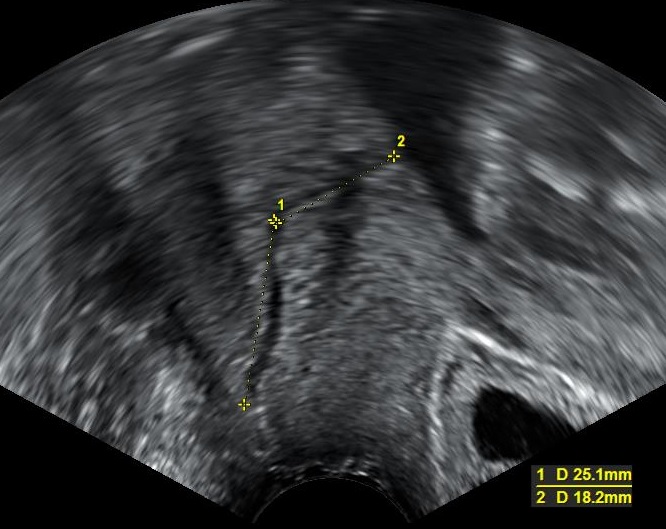
Illustrative example — public domain (CC0); not a Balaji Horizon patient image.
Your fetal-medicine specialist
Your cervical-length scan is performed and interpreted by a clinician dedicated to fetal medicine, on advanced GE Voluson™ S10 Expert imaging, with a direct pathway to senior gynaecologist Dr. Priyadatt Patel for any pregnancy that needs obstetric care.

Dr. Mayank Chaudhary
An ISUOG-trained fetal-medicine consultant who performs cervical-length assessment and detailed fetal scans to international standards.
Standards & further reading. Our protocol aligns with the ISUOG practice guidelines for cervical assessment. For independent patient information see the NHS guide to pregnancy ultrasound.
Related fetal scans
Frequently Asked Questions
Evidence-based answers about the cervical length scan.
Is the transvaginal probe safe in pregnancy?
Yes. Transvaginal ultrasound is safe throughout pregnancy. The probe is inserted approximately 3 cm into the vagina — it does not contact the cervix, and does not pose any risk of membrane rupture or stimulation of preterm labour. ISUOG guidelines specifically endorse transvaginal CL measurement as safe and preferable to transabdominal measurement for accuracy.
At what week is the cervical length scan done?
Standard screening: 20–24 weeks, typically combined with the anomaly scan appointment. In high-risk women (prior preterm birth, prior cerclage, prior late miscarriage, uterine anomaly): serial CL monitoring begins from 14–16 weeks onwards, with repeat scans every 2–4 weeks depending on findings.
My cervix was short at 20 weeks — does that mean I will deliver early?
Not necessarily. A short cervix significantly increases statistical risk, but with appropriate management — vaginal progesterone and cerclage where indicated — many women carry to term or near-term. The cervical length finding is an opportunity for intervention, not a fixed outcome. Risk is stratified by CL measurement, obstetric history, and clinical findings to personalise management.
Can cervical incompetence be detected before pregnancy?
In most cases, no. Cervical insufficiency is diagnosed clinically based on obstetric history — painless cervical dilation in the second trimester, recurrent late miscarriages — and confirmed on transvaginal scanning in subsequent pregnancies. Pre-pregnancy cervical assessment has limited predictive value. If you have a relevant history, early CL monitoring in the next pregnancy is strongly recommended.
What is a cervical cerclage?
A cerclage is a surgical suture placed around the cervix under spinal or general anaesthesia to mechanically prevent premature opening. It is typically performed between 12–16 weeks as a planned (elective) procedure in high-risk women, or as a rescue procedure when cervical shortening is detected in the second trimester. It is removed at 36–37 weeks of gestation or earlier if preterm labour begins.
Book Your Cervical Length Scan in Ahmedabad
Transvaginal CL measurement for preterm risk assessment. High-risk monitoring from 14 weeks. Direct integration with obstetric team for cerclage decisions. Science City Road & Naranpura.
Related Fetal Medicine Scans
Dr. Priyadatt Patel
Senior Gynecologist · Advanced Laparoscopic Surgeon · IVF and Endometriosis Programme Lead
MS OBGyn · Pregnancy Care · Advanced Gynaecological Ultrasound · Fertility Preservation
ESHRE / ESGE / AAGL / ASRM guideline-aligned practice. 3D Karl Storz precision technique. Fertility-preservation-first philosophy. Evidence-based decisions, honest counselling, long-term outcomes orientation.
Science City Road, Ahmedabad 380060
Mon–Sat 11:00–20:00 · +91 97234 31544
Naranpura, Ahmedabad
Mon–Sat 08:30–10:30 · +91 70460 02566
A short cervix is one of the strongest predictors of early birth — read about the warning signs of preterm labour and what to do.