

Placenta & Amniotic Fluid Assessment — AFI Scan
Placental location, grade, and function assessment combined with amniotic fluid index — a critical scan for safe birth planning.
What Does the Placenta & AFI Scan Assess?
This scan provides a comprehensive evaluation of both the placenta and the amniotic fluid — two parameters that directly influence delivery planning, fetal wellbeing interpretation, and obstetric risk stratification.
Placental Assessment
- Location — anterior, posterior, fundal, lateral, low-lying
- Distance from internal os — placenta praevia diagnosis
- Grade (Grannum 0–3) — calcification and maturation pattern
- Morphology — irregular, circumvallate features
- Retroplacental space — haematoma identification
- Placental accreta spectrum screening (Doppler correlation)
Amniotic Fluid Assessment
Normal: 8–24 cm. Sum of deepest pockets in four uterine quadrants.
Associated with FGR, post-dates pregnancy, fetal renal anomalies, membrane rupture.
Associated with maternal diabetes, fetal swallowing disorders, structural anomalies, or idiopathic.
Alternative single-pocket method. MVP <2 cm = oligohydramnios. MVP >8 cm = polyhydramnios.
Low-Lying Placenta and Placenta Praevia — What You Need to Know
The most clinically significant placental finding requiring structured follow-up and delivery planning. Early identification changes obstetric management entirely.
| Finding | Definition | Clinical Implication |
|---|---|---|
| Normal location | Placental edge >20 mm from internal os | No restriction on delivery mode |
| Low-lying placenta | Placental edge <20 mm from os but not covering it | Follow-up TV scan at 32 weeks and 36 weeks; most will migrate up |
| Placenta praevia | Placental edge covers the internal os | Caesarean section required; elective LSCS at 36–38 weeks; no vaginal examination |
| Placenta accreta spectrum | Abnormal adherence to uterine wall | Requires colour Doppler + clinical correlation; high surgical risk at delivery |
Follow-Up Protocol for Low-Lying Placenta
If low-lying placenta is identified at the 18–22 week anomaly scan: repeat transabdominal ultrasound at 32 weeks. If still low at 32 weeks: transvaginal scan at 36 weeks for precise os distance. Approximately 90% of low-lying placentas at 20 weeks will migrate upward by term and not require caesarean delivery on this basis alone.
Placenta & AFI Scanning at Balaji Horizon
Comprehensive placental and fluid assessment with colour Doppler, transvaginal capability, and direct specialist correlation at Ahmedabad.
Placental vascularity assessment including uterine artery flow, basal plate Doppler for accreta screening, and colour mapping of retroplacental space.
TV scan provides significantly more accurate internal os distance measurement than transabdominal approach. Used when low-lying placenta needs precise classification — safe to perform in all presentations.
Structured follow-up protocol for low-lying placentas identified at anomaly scan. Placenta accreta spectrum screening with Doppler when clinically indicated.
Coordination with Dr. Priyadatt Patel for all placenta praevia and accreta spectrum cases. Delivery planning, theatre preparation, and multidisciplinary approach for high-risk placentation.
Images from our Voluson S10 Expert
Examples of placental and umbilical-cord blood-flow imaging this system produces at Balaji Horizon:
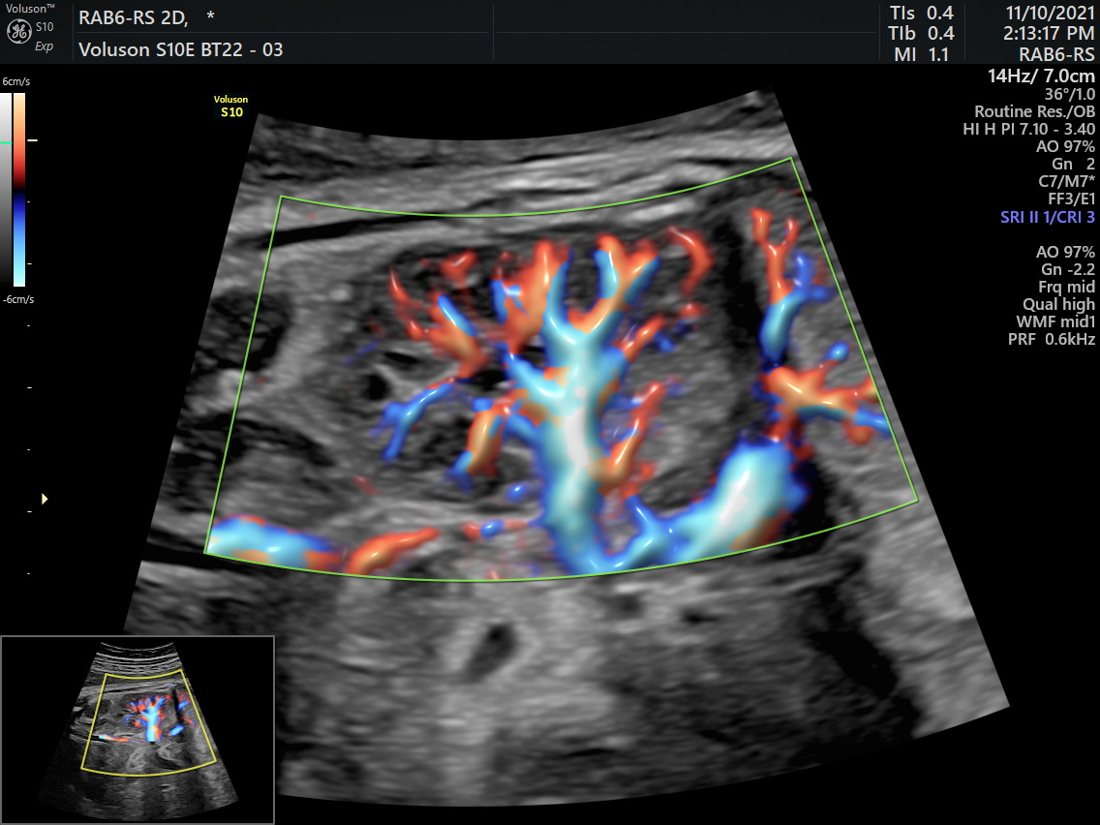
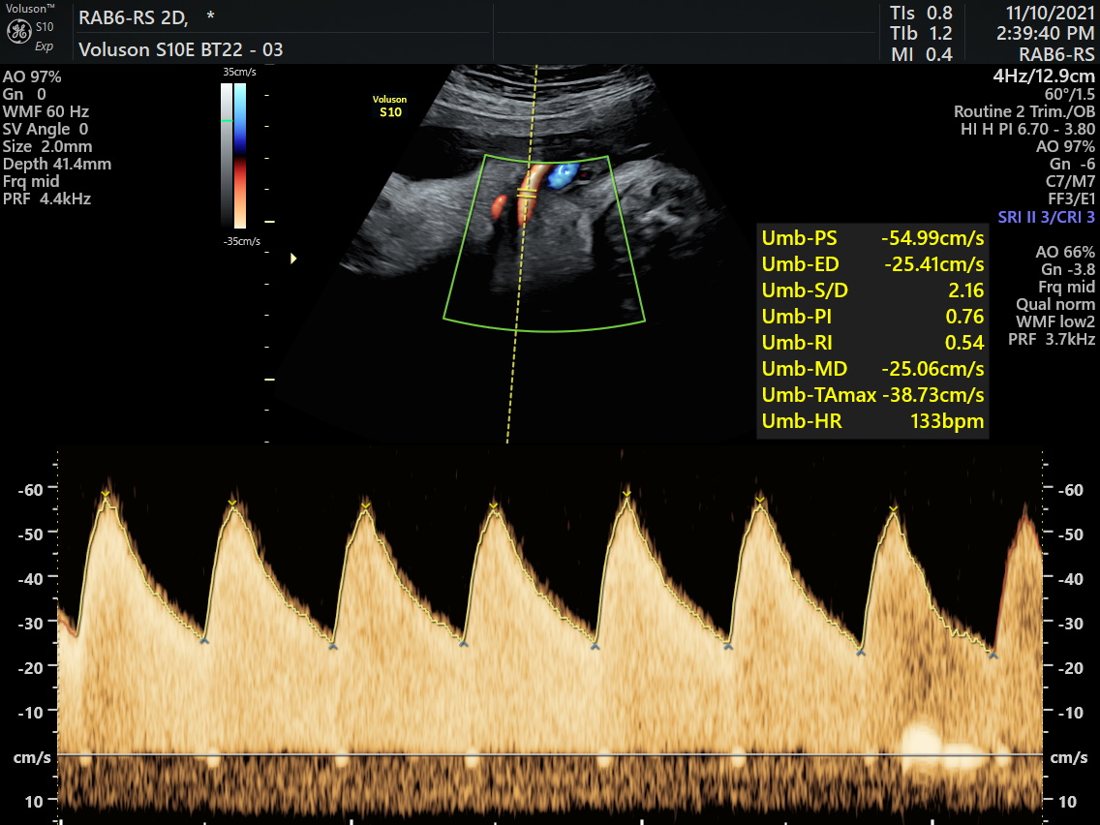
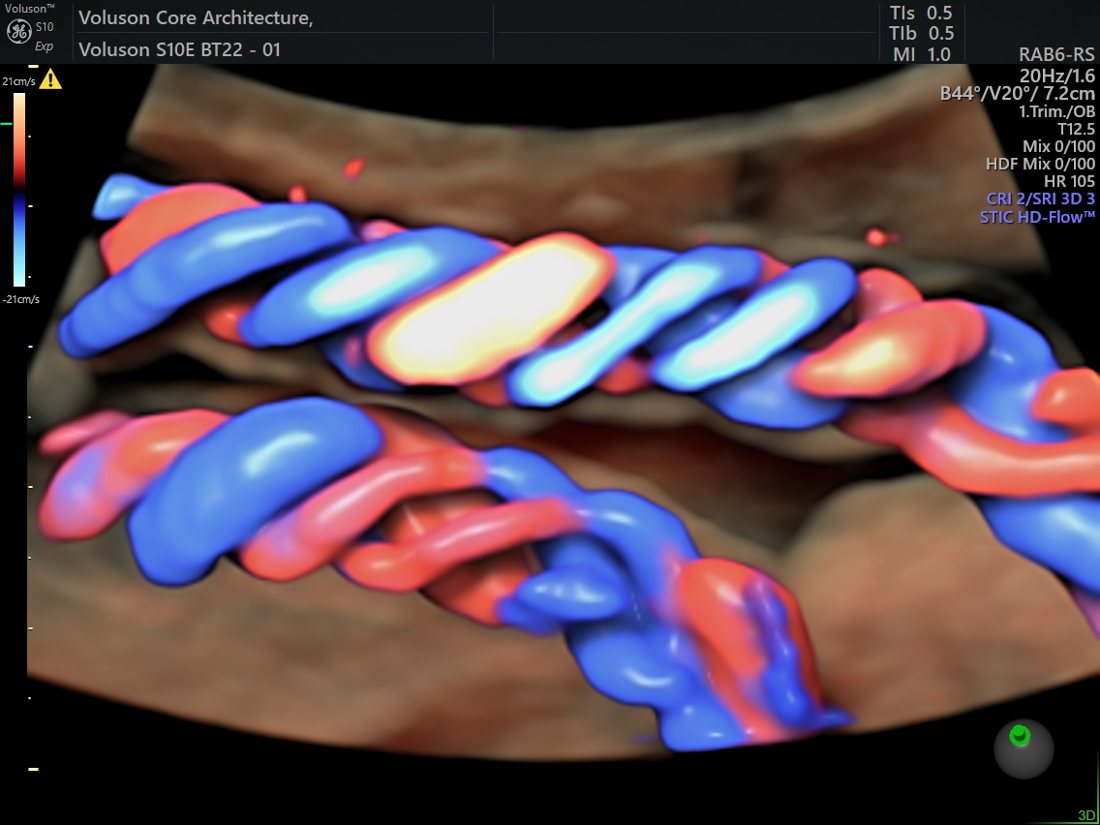
Actual images acquired on our GE Voluson™ S10 Expert. “GE”, “Voluson”, “HDlive” and “Radiantflow” are trademarks of GE HealthCare; shown with permission.
Your fetal-medicine specialist
Your placenta and amniotic-fluid assessment is performed and interpreted by a clinician dedicated to fetal medicine, with a direct pathway to senior gynaecologist Dr. Priyadatt Patel for any pregnancy that needs obstetric care.

Dr. Mayank Chaudhary
An ISUOG-trained fetal-medicine consultant who performs detailed fetal assessments to international standards.
Standards & further reading. Our protocol aligns with the ISUOG practice guidelines. For independent patient information see the NHS guide to pregnancy ultrasound.
Related fetal scans
Frequently Asked Questions
Evidence-based answers about placenta and amniotic fluid assessment.
My placenta is low-lying at 20 weeks — should I be worried?
Not necessarily. The uterus grows significantly between 20 and 36 weeks. As the lower uterine segment develops, the placenta appears to migrate upward relative to the internal os. Approximately 90% of low-lying placentas identified at 20 weeks will resolve by 32–36 weeks and require no special delivery intervention. A follow-up scan at 32 weeks will provide clarity.
What is reduced amniotic fluid (oligohydramnios)?
AFI below 5 cm (or MVP below 2 cm) indicates oligohydramnios — reduced amniotic fluid volume. Causes include fetal growth restriction, post-dates pregnancy, fetal renal anomalies, and early membrane rupture. When oligohydramnios is found, Doppler studies are typically arranged alongside to assess placental function and fetal wellbeing.
Is too much amniotic fluid (polyhydramnios) dangerous?
Mild polyhydramnios (AFI 25–29 cm) is often idiopathic and clinically benign. Moderate-to-severe polyhydramnios warrants investigation — the most important causes to exclude are gestational diabetes, fetal swallowing disorders (oesophageal or duodenal atresia), and structural anomalies. Severe polyhydramnios carries a risk of preterm labour and umbilical cord prolapse at membrane rupture.
What is placental grading and does it matter?
Grannum grading (0–3) describes placental calcification patterns as pregnancy advances. Grade 3 before 36 weeks was historically considered an adverse marker (“ageing placenta”) but current evidence does not support using it in isolation to guide management. It is noted in reports as a descriptive finding. Clinical decisions are based on Doppler, biometry, and AFI rather than placental grade alone.
Do I need a transvaginal scan for the placenta assessment?
Transabdominal scan is always the first approach. If the placental edge appears within 30–40 mm of the internal os on transabdominal scan, a transvaginal scan is performed — it provides significantly more accurate measurement of os distance and is the standard for placenta praevia classification. Transvaginal scanning is safe in all cases of low-lying placenta and does not increase bleeding risk.
Book Your Placenta & AFI Scan in Ahmedabad
Comprehensive placental location, grading, and amniotic fluid assessment. Follow-up protocol for low-lying placenta. Science City Road & Naranpura, Ahmedabad.
Related Fetal Medicine Scans
Dr. Priyadatt Patel
Senior Gynecologist · Advanced Laparoscopic Surgeon · IVF and Endometriosis Programme Lead
MS OBGyn · Pregnancy Care · Advanced Gynaecological Ultrasound · Fertility Preservation
ESHRE / ESGE / AAGL / ASRM guideline-aligned practice. 3D Karl Storz precision technique. Fertility-preservation-first philosophy. Evidence-based decisions, honest counselling, long-term outcomes orientation.
Science City Road, Ahmedabad 380060
Mon–Sat 11:00–20:00 · +91 97234 31544
Naranpura, Ahmedabad
Mon–Sat 08:30–10:30 · +91 70460 02566