
Chronic Pelvic Pain: Why Diagnosis Takes Time and How It’s Evaluated
Reading time: about 7 minutes. This article is educational and does not replace an individual consultation.
Living with pelvic pain that comes back month after month — or never fully goes away — is exhausting, and being told “the tests are normal” can feel dismissive. Chronic pelvic pain is real, common, and often has more than one contributing cause, which is exactly why it can take time to diagnose. This article explains why, and how a careful evaluation works.
Who this article is for
This is for women in Ahmedabad and Gujarat who have had pelvic pain for six months or more and want their experience taken seriously and assessed properly.
What chronic pelvic pain is
Chronic pelvic pain is pain in the lower abdomen or pelvis lasting six months or more. It affects a significant proportion of women, and it is best understood not as a single disease but as a symptom that can arise from several sources at once [Source: ACOG guidance on chronic pelvic pain; RCOG guideline].
Why diagnosis takes time
Most women with chronic pelvic pain have more than one contributing factor — for example, a gynaecological condition together with bladder, bowel, musculoskeletal, or nerve-related components. Because the causes overlap, and because some conditions (such as endometriosis) are not always visible on a scan, a single test rarely gives the whole answer. This is why the journey can be frustrating — not because the pain is imagined [Source: ACOG guidance].
Common contributing causes
- Gynaecological — endometriosis, adenomyosis, ovarian conditions
- Bladder — painful bladder syndrome / interstitial cystitis
- Bowel — irritable bowel syndrome and related conditions
- Musculoskeletal — pelvic floor muscle dysfunction
- Nerve-related and central — changes in how pain signals are processed over time
Several of these often coexist, which shapes how treatment is approached.
How it is evaluated
A good assessment starts by taking your pain history seriously — its pattern, triggers, and effect on your life — followed by examination and targeted investigations such as ultrasound. The aim is to identify the contributing factors rather than to chase a single label, and to do so without unnecessary, repeated procedures [Source: RCOG guideline on chronic pelvic pain]. A normal scan does not mean nothing is wrong.
How it is managed
Because chronic pelvic pain is often multifactorial, the most effective approach is usually multidisciplinary — addressing each contributing factor, which may combine medical treatment, pelvic floor physiotherapy, management of bladder or bowel components, and support for the way pain is experienced. Treating one cause in isolation may not resolve the whole picture [Source: ACOG guidance].
What to ask
- What do you think is contributing to my pain?
- Could endometriosis or another condition not seen on a scan be involved?
- What is the plan if the first approach does not fully help?
- Who else might be part of my care?
Chronic pelvic pain care in Ahmedabad
Chronic pelvic pain deserves a thorough, validating assessment and a plan that addresses all the contributing factors. Balaji Horizon Women’s Hospital, on Science City Road in Ahmedabad, evaluates chronic pelvic pain carefully — using expert imaging and a multidisciplinary approach rather than treating the pain in isolation.
When to seek advice
See a gynaecologist if pelvic pain has lasted six months or more, is affecting your daily life, or has not been explained by previous assessments. Persisting pain that has been dismissed is worth a fresh, structured look [Source: RCOG guideline].
A note on next steps
For a thorough chronic pelvic pain assessment, our team can help. Read more on our endometriosis and gynaecology pages.
Frequently asked questions
Why have my tests come back normal if I am in pain?
Some causes of chronic pelvic pain, such as superficial endometriosis or pelvic floor dysfunction, are not always visible on standard tests, and pain often has several contributing factors. Normal tests do not mean the pain is imagined — they mean the assessment needs to continue [Source: ACOG guidance].
Could my pain be endometriosis?
Endometriosis is a common cause of chronic pelvic pain and is not always seen on a scan, so it should be considered as part of the assessment, especially if your pain is cyclical or associated with periods, intercourse, or bowel and bladder symptoms [Source: ESHRE Endometriosis Guideline, 2022].
Will I need surgery to find the cause?
Not necessarily. Many contributing factors can be identified and managed without surgery. Where laparoscopy is considered, it is for specific reasons, weighed carefully rather than used as a routine search [Source: RCOG guideline].
Why is a multidisciplinary approach recommended?
Because chronic pelvic pain often has more than one cause, addressing only one may not resolve it. Combining treatments — medical, physiotherapy, and support for how pain is processed — tends to be more effective [Source: ACOG guidance].
Is chronic pelvic pain treatable?
Yes — while it can be complex, many women improve significantly once the contributing factors are identified and addressed together. A structured, validating assessment is the starting point.
Disclaimer: This article is for educational purposes only and does not replace a consultation with a qualified gynaecologist. Chronic pelvic pain must be assessed individually.

Free Patient Guide
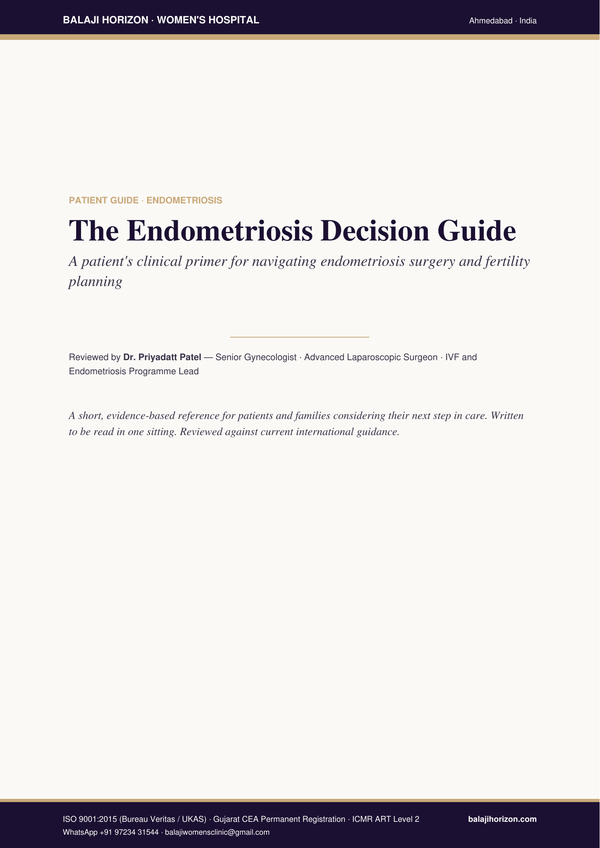
The Endometriosis Decision Guide
A short clinical primer on diagnostic delay, the four decisions you may face, and what to bring to your specialist consultation. Aligned with ESHRE 2022, ASRM, FIGO guidance.
Get the guide →