
Endometriosis and Infertility: What You Need to Know
Up to 50% of women with infertility have endometriosis, and up to half of women with endometriosis struggle to conceive. This page explains the biological mechanisms, the diagnostic pathway, and the surgery-versus-IVF decisions that determine your real-world chance of a baby.
1. The biological link — why endometriosis lowers fertility
Endometriosis affects fertility through several pathways simultaneously: distorted pelvic anatomy from adhesions and endometriomas; impaired oocyte quality through chronic peritoneal inflammation; reduced ovarian reserve from the disease itself or from prior surgery; and an altered endometrial environment that impairs implantation even when good embryos are transferred. The cumulative effect is greater than any single mechanism suggests.
2. How endometriosis is diagnosed (and why it is missed)
Average delay to diagnosis is still 7–10 years globally. Transvaginal ultrasound by an experienced sonographer can detect ovarian endometriomas, deep infiltrating lesions of the rectovaginal septum and uterosacrals, and frozen-pelvis signs. MRI adds value for deep disease and bowel involvement. Laparoscopy remains the gold standard for superficial peritoneal disease and definitive histology. We diagnose by structured pelvic exam, expert ultrasound and selective MRI — surgery is reserved for cases where it changes management.
3. Endometrioma — the high-stakes ovarian decision
An endometrioma over 3 cm is associated with reduced AMH and lower oocyte yield. But surgical removal further reduces ovarian reserve, especially if technique is not meticulous. For women planning IVF, current ESHRE 2022 guidance often favours IVF first, surgery later for asymptomatic small endometriomas. For symptomatic large endometriomas or suspected malignancy, careful cystectomy by an experienced laparoscopic surgeon is appropriate. AMH should always be measured before any ovarian surgery.
4. Stage of endometriosis and pregnancy chance
Stage I–II (minimal–mild): laparoscopic excision improves natural conception rates by about 8–10 percentage points (RCT-level evidence). Stage III–IV (moderate–severe): surgery improves spontaneous conception only in selected cases; for many, IVF is the more efficient route. Adenomyosis coexists in 30–80% of severe endometriosis and is an independent negative factor for implantation. Stage alone does not predict outcome — anatomic distortion, ovarian reserve and adenomyosis matter more.
5. Surgery before IVF — when and when not
Surgery is appropriate when pain is the primary concern, when tubal disease is a clear factor, when hydrosalpinx is present (always remove or clip before IVF), when endometrioma is large/symptomatic/suspicious, or when prior IVF has failed with documented deep disease. Surgery is generally not appropriate when ovarian reserve is already low, the patient is asymptomatic, or repeat surgery is being considered without a clear new indication. Each repeat surgery erodes ovarian reserve.
6. IVF in endometriosis — protocol choices that matter
Long agonist down-regulation for 2–3 months before stimulation has been associated with higher implantation rates in stage III–IV disease in some studies. Antagonist protocols are appropriate for low-reserve patients. Freeze-all and deferred frozen embryo transfer reduces inflammatory exposure and is increasingly preferred. Adenomyosis may warrant additional GnRH suppression before transfer. Endometrial preparation is individualised, not protocolised.
7. Fertility preservation — a conversation we have too rarely
Young women with severe endometriosis, especially before repeat surgery, should be offered oocyte freezing or embryo freezing if a partner is identified. AMH below 1.0 ng/ml or surgical history involving both ovaries are particularly strong indications. Fertility preservation is most effective before, not after, ovarian damage — the conversation belongs in the very first endometriosis consultation.
8. The Balaji Horizon approach
Our endometriosis programme integrates expert ultrasound mapping, individualised medical management, precision excisional surgery only when warranted, and IVF planning aligned with disease stage and ovarian reserve. Decisions are made jointly between the patient, our reproductive medicine team and our advanced laparoscopic surgeons. The goal is not heroic surgery — it is the highest cumulative chance of a healthy baby with the lowest cost to ovarian reserve.
Frequently Asked Questions
How does endometriosis cause infertility?
Should I have surgery before trying IVF?
Will endometriosis surgery improve my chances of pregnancy?
Can I get pregnant naturally with endometriosis?
How does endometriosis affect IVF success?
Is fertility preservation right for me?
Can adenomyosis be treated alongside endometriosis?
Where can I get a specialist opinion on endometriosis and fertility?

Weighing surgery against IVF? Read: Endometriosis & fertility — surgery, IVF, or both?
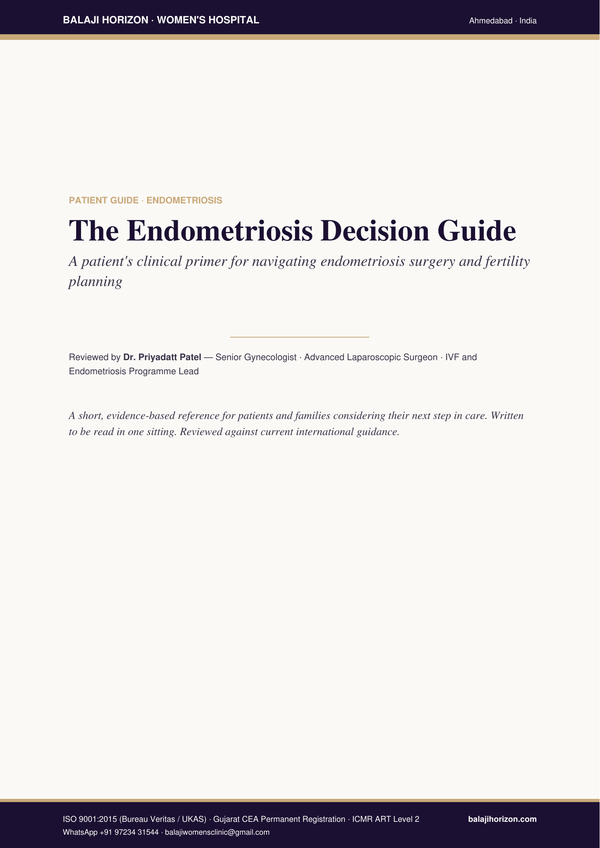
Free Patient Guide
The Endometriosis Decision Guide
A short clinical primer on diagnostic delay, the four decisions you may face, and what to bring to your specialist consultation. Aligned with ESHRE 2022, ASRM, FIGO guidance.
Get the guide →Related: Been told your egg reserve is low? See our honest guide to IVF with low AMH in Ahmedabad — what the number really means.