
Laparoscopic Surgery for Endometriosis: When Is It Needed & What to Expect
Laparoscopic surgery remains one of the most significant interventions in endometriosis management — but it is also one of the most frequently misapplied. Understanding when surgery is genuinely indicated, what it can realistically achieve, and what the long-term implications are is essential for anyone managing this disease.
This guide explains the role of laparoscopy in endometriosis, written from the perspective of Dr. Priyadatt Patel at Balaji Horizon Women’s Hospital, Ahmedabad — a centre specialising in advanced laparoscopic gynaecology and endometriosis management.
What Is Laparoscopic Surgery?
Laparoscopy is a minimally invasive surgical technique in which a thin, lighted camera (laparoscope) is inserted through a small incision near the navel. Additional small incisions allow surgical instruments to be introduced. The procedure is performed under general anaesthesia, typically as a day case or with one night in hospital.
In endometriosis, laparoscopy serves two purposes: diagnostic confirmation and surgical treatment. It remains the only definitive way to diagnose endometriosis, as imaging (ultrasound and MRI) cannot reliably detect all forms of the disease — particularly superficial peritoneal implants.
Why Endometriosis Surgery Is Complex
Endometriosis is not a uniform disease. It exists on a spectrum:
- Superficial peritoneal endometriosis: Small implants on the peritoneal lining — variable in behaviour, often not correlating with pain severity
- Ovarian endometrioma (chocolate cyst): Cystic collections of endometriotic tissue within the ovary — associated with ovarian reserve impact and fertility implications
- Deep infiltrating endometriosis (DIE): Lesions invading more than 5mm beneath the peritoneal surface, affecting structures including the uterosacral ligaments, bowel, bladder, and ureters — the most complex form requiring the highest surgical expertise
The extent and location of disease, the patient’s symptoms, fertility goals, ovarian reserve, age, and previous surgical history all determine whether surgery is appropriate, what type of surgery is needed, and when it should be performed relative to fertility treatment.
When Is Laparoscopy Indicated for Endometriosis?
Surgery is not the default answer for all endometriosis. The decision requires careful, individualised assessment.
Diagnostic Laparoscopy
Diagnostic laparoscopy is considered when:
- Clinical suspicion of endometriosis is high based on symptoms (dysmenorrhoea, deep dyspareunia, non-menstrual pelvic pain, cyclical bowel or bladder symptoms)
- Imaging is negative or inconclusive but symptoms are severe and affecting quality of life
- Medical treatment has failed to adequately control symptoms
- Fertility evaluation requires ruling out tubal disease or peritoneal disease
When possible, a diagnostic laparoscopy should be planned as an operative procedure — i.e., if endometriosis is found, it should be treated at the same time. Staging the procedure into a separate diagnostic and then a separate surgical procedure, without a clear clinical reason, is not recommended by current ESHRE guidelines.
Surgical Laparoscopy for Pain
Surgical excision or ablation of endometriotic lesions is appropriate when:
- Medical management (hormonal therapy, NSAIDs) has provided insufficient symptom control
- The patient wishes to avoid or cannot tolerate long-term hormonal suppression
- There is an ovarian endometrioma ≥4 cm that is symptomatic or affecting ovarian reserve
- Deep infiltrating endometriosis is causing significant functional impairment (bowel obstruction, ureteral involvement, severe bladder symptoms)
Surgical Laparoscopy for Fertility
The decision to operate for fertility purposes is more nuanced and requires balancing surgical benefit against ovarian reserve risk:
- Minimal-mild endometriosis: Laparoscopic surgery modestly improves spontaneous conception rates (ENDOCAN trial data). However, this benefit must be weighed against the risks of surgery and the availability of IVF as an alternative
- Ovarian endometrioma: Surgery before IVF is not automatically beneficial. Repeated cystectomy significantly damages ovarian reserve. The decision must be individualised based on cyst size, anti-Müllerian hormone (AMH), antral follicle count, and patient age
- Deep infiltrating endometriosis: May improve implantation rates in selected cases, but evidence is evolving. Multidisciplinary input is essential
Excision vs Ablation: What Is the Difference?
There are two primary techniques for treating visible endometriotic lesions:
Excision (Surgical Removal)
Excision involves cutting out the endometriotic tissue completely — including the base of the lesion. This requires precise dissection, careful identification of tissue planes, and advanced surgical skill. It is considered the gold standard for most forms of endometriosis, particularly deep infiltrating lesions, and provides histological confirmation of the diagnosis.
Benefits of excision include lower recurrence rates compared to ablation for deep disease and the ability to confirm the diagnosis pathologically.
Ablation (Destruction)
Ablation uses energy sources (laser, monopolar or bipolar diathermy) to destroy the surface of endometriotic tissue without removing it. This is faster and technically simpler, but does not excise deep lesions completely, does not provide histological specimens, and may have higher recurrence rates for deeper disease.
Ablation may be appropriate for superficial peritoneal disease in certain clinical contexts, but excision is preferred wherever the lesion depth and location allow it safely.
Ovarian Endometrioma: The Surgical Dilemma
Ovarian endometriomas require particularly careful consideration. The ovarian cortex — the tissue that contains primordial follicles — is closely adherent to the inner wall of an endometrioma. During cystectomy, some normal ovarian cortex is inevitably removed along with the cyst wall, even by experienced surgeons.
The impact on ovarian reserve is well-documented:
- AMH typically drops after endometrioma cystectomy
- The drop is greater with larger cysts and bilateral disease
- With repeat surgery, the cumulative damage can be significant
- In patients with already reduced ovarian reserve or bilateral endometriomas, surgery may cause more harm than benefit
This is why the decision to operate on an endometrioma before IVF requires an honest analysis of the available evidence. Current ESHRE guidelines do not recommend routine cystectomy before IVF solely to improve outcomes unless the cyst is symptomatic, causing access difficulties for egg retrieval, or has characteristics suspicious for malignancy.
Deep Infiltrating Endometriosis: Surgical Complexity
Deep infiltrating endometriosis (DIE) — involving the uterosacral ligaments, rectovaginal septum, bowel, bladder, or ureters — represents the most surgically demanding form of the disease. Complete excision of DIE requires:
- Thorough preoperative mapping (transvaginal ultrasound, MRI, and in some cases colonoscopy or cystoscopy)
- Multidisciplinary surgical teams when bowel or urological involvement is confirmed
- Surgical expertise in advanced dissection, including nerve-sparing techniques to preserve bladder and bowel function
- Careful patient counselling regarding the risks of injury to adjacent structures
DIE surgery carries higher complication rates than surgery for superficial disease or endometrioma alone. The decision to operate must weigh the potential functional benefit against these risks, and patients must be fully informed of realistic outcomes including the possibility of incomplete excision and symptom persistence.
What to Expect: Before, During, and After Surgery
Preoperative Assessment
Before laparoscopy, a thorough clinical evaluation is performed:
- Detailed symptom assessment (pain mapping, bowel and bladder symptoms, cycle-related patterns)
- Transvaginal ultrasound with a dedicated endometriosis protocol
- MRI pelvis where deep infiltrating disease or complex anatomy is suspected
- Baseline ovarian reserve assessment (AMH, antral follicle count) for women with fertility concerns
- Discussion of realistic expectations, risks, and the role of medical management post-surgery
During Surgery
Laparoscopic surgery for endometriosis is performed under general anaesthesia. Typical operative time ranges from 30 minutes for limited disease to several hours for complex deep infiltrating endometriosis. The approach is tailored to the extent of disease identified on preoperative mapping and confirmed at laparoscopy.
Intraoperative findings may differ from what was anticipated on imaging — either more or less disease may be found. The surgical plan is adapted accordingly.
Postoperative Recovery
Recovery depends on the extent of surgery performed:
- Simple diagnostic or superficial disease: Discharge same day or next day, return to light activities within 3–5 days, full recovery within 1–2 weeks
- Endometrioma cystectomy: Similar recovery, though more discomfort may be expected
- Complex DIE excision: Longer hospital stay (2–5 days), return to normal activities over 2–6 weeks depending on the structures involved
Postoperative hormonal therapy is typically recommended to reduce the risk of disease recurrence, unless the patient is actively trying to conceive.
Recurrence After Surgery: Setting Realistic Expectations
Endometriosis recurrence after surgery is a well-documented phenomenon. Reported recurrence rates vary depending on disease stage, extent of surgery, and whether postoperative hormonal suppression is used:
- Superficial disease: Higher recurrence risk if hormonal suppression is not used after surgery
- Endometrioma: Recurrence rates of 15–30% within 5 years, particularly without postoperative hormonal management
- DIE: Recurrence is lower with complete excision but depends heavily on surgical completeness
Repeat surgery carries increasing risks — including progressive ovarian reserve damage and adhesion formation. Long-term planning, rather than reactive surgery at each recurrence, is essential. For women not planning pregnancy, continuous hormonal suppression after surgery offers the best protection against recurrence.
Laparoscopy and Fertility: Integrating Surgery and IVF
For women with endometriosis who are trying to conceive, the relationship between surgery and IVF requires careful thought:
- Surgery may improve spontaneous conception rates in mild endometriosis, but this benefit diminishes with increasing surgical complexity and declining ovarian reserve
- For women with reduced ovarian reserve, particularly those with bilateral endometriomas, proceeding directly to IVF treatment without surgery may be the safer and more effective strategy
- Timing matters: after endometrioma surgery, the window for IVF should be planned carefully, as AMH may take several months to partially recover — and in some cases does not
- The combination of endometriosis surgery and fertility preservation (oocyte cryopreservation) should be discussed with young patients with bilateral or recurrent endometriomas
There is no universal algorithm. The right sequence of interventions depends on the patient’s age, ovarian reserve, symptom burden, disease extent, previous surgical history, and personal priorities.
Why Surgical Expertise Matters in Endometriosis
Endometriosis surgery is not equal in all hands. The completeness of excision, the preservation of adjacent structures, the avoidance of unnecessary ovarian damage, and the long-term outcome for the patient are all directly influenced by the surgeon’s experience, anatomical knowledge, and judgment.
This is particularly important for deep infiltrating endometriosis, where inadequate surgery — whether incomplete excision or inadvertent injury — can leave patients worse off than careful medical management.
At Balaji Horizon Women’s Hospital, laparoscopic surgery for endometriosis is performed using 3D high-definition laparoscopy, which provides enhanced depth perception and surgical precision compared to standard 2D systems. This is of particular value in complex cases where precise dissection in close proximity to the ureter, bowel, or bladder is required.
Consulting Dr. Priyadatt Patel
If you are living with endometriosis — whether newly diagnosed, considering surgery, or managing decisions about fertility — an individualised consultation is the starting point. At Balaji Horizon Women’s Hospital, the approach to endometriosis is evidence-based, fertility-conscious, and long-term in its orientation. Surgery is recommended when it serves the patient’s specific goals — not as a default response to diagnosis.
To book a consultation with Dr. Priyadatt Patel, contact Balaji Horizon Women’s Hospital at +91 99094 96027 or visit our centre on Science City Road, Ahmedabad.
Frequently Asked Questions
Do I definitely need surgery for endometriosis?
Not always. Many women are managed effectively with medical therapy for years. Surgery earns its place when pain persists despite medical treatment, for deep disease distorting the anatomy, or for specific fertility reasons — decided individually, never by a one-size rule (ESHRE 2022).
Will laparoscopy for endometriosis help me conceive?
It can in selected cases, but it is weighed against IVF and against the risk of reducing ovarian reserve. The decision integrates your age, ovarian reserve, disease map and fertility goals rather than treating surgery as automatic (ESHRE).
Does removing a chocolate cyst (endometrioma) damage the ovary?
Cystectomy can lower ovarian reserve (reflected in AMH), more so with bilateral or large cysts. This is precisely why surgery is not reflexive — before IVF in particular, removing an endometrioma is often not recommended (ESHRE 2022).
Does endometriosis come back after surgery?
Recurrence is possible — roughly 20–50% over five years depending on the disease phenotype — which is why surgery is paired with a long-term management plan rather than viewed as a one-time cure.
Is keyhole surgery better than open surgery for endometriosis?
Yes. Laparoscopy is the standard approach, allowing magnified, precise, fertility-preserving excision with less pain and faster recovery — best performed by an experienced endometriosis surgeon.
Should I have surgery before trying IVF for endometriosis?
Not routinely. In many cases IVF is appropriate without prior surgery, particularly to protect ovarian reserve. Surgery before IVF is reserved for specific indications, decided individually (ESHRE).
How is endometriosis mapped before surgery?
Increasingly through expert ultrasound, and MRI in selected cases, using a structured protocol — so that surgery, if needed, is planned and precise rather than exploratory.
What is deep infiltrating endometriosis (DIE)?
It is endometriosis penetrating more than 5mm below the surface, sometimes involving the bowel, bladder or ureters. It needs careful mapping and an experienced surgical team.
Will I need repeat surgery for endometriosis?
Sometimes, given the recurrence rate — which is exactly why a fertility-preserving, considered first operation paired with a long-term plan matters more than aggressive repeat surgery.

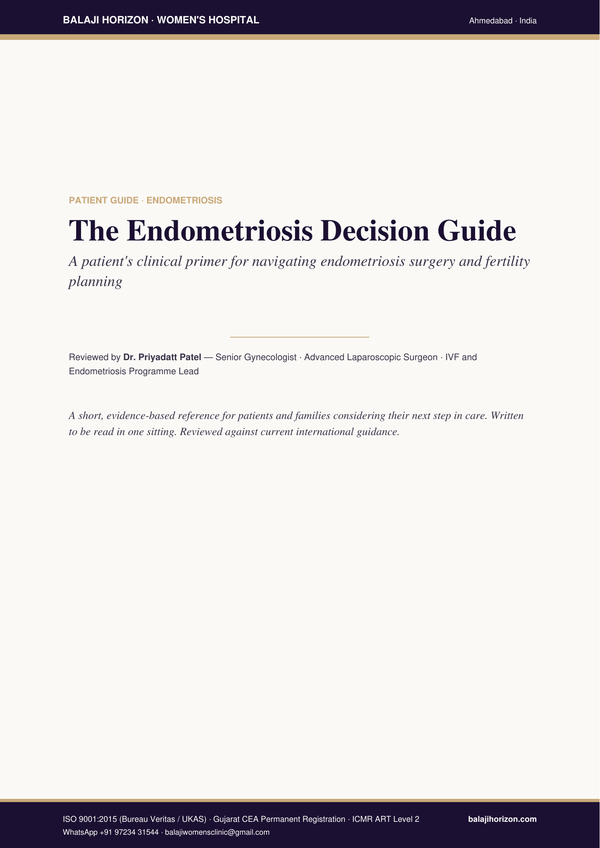
Free Patient Guide
The Endometriosis Decision Guide
A short clinical primer on diagnostic delay, the four decisions you may face, and what to bring to your specialist consultation. Aligned with ESHRE 2022, ASRM, FIGO guidance.
Get the guide →For complex, deep or recurrent disease, see how Dr. Priyadatt Patel approaches advanced laparoscopic gynaecological surgery in Ahmedabad with a fertility-preserving, conservative-first philosophy.