
IVF Process in India: A Step-by-Step Guide to Treatment, Timeline & What to Expect
For most couples beginning the IVF journey, the process feels both medically complex and emotionally overwhelming. Understanding what actually happens — step by step, from the first consultation through to the embryo transfer — removes much of the uncertainty and helps couples make informed decisions at each stage.
This guide explains the IVF process as practised at Balaji Horizon Women’s Hospital in Ahmedabad, under the clinical direction of Dr. Priyadatt Patel. The aim is to provide accurate, realistic information — not a simplified version that glosses over the variables that genuinely affect outcomes.
Before IVF Begins: Assessment and Planning
IVF is not a uniform treatment. It is a protocol that must be adapted to the specific clinical profile of each couple. Before stimulation begins, a thorough evaluation is essential:
For the Woman
- Ovarian reserve assessment: Anti-Müllerian hormone (AMH), antral follicle count (AFC) on ultrasound, and baseline FSH/LH on day 2 or 3 of the cycle. These parameters determine the expected ovarian response and guide protocol selection and medication dosing.
- Uterine evaluation: A detailed pelvic ultrasound assesses the endometrial lining, uterine cavity, and any structural abnormalities (fibroids, polyps, septum, or adhesions) that could affect implantation. A saline infusion sonohysterography or hysteroscopy may be recommended if the cavity appears abnormal.
- Hormonal and infectious panel: Thyroid function, prolactin, haematological screen, blood group, and screening for infections including hepatitis B, hepatitis C, and HIV.
For the Male Partner
- Semen analysis: Count, motility, morphology, and vitality. A single semen analysis should not be taken as definitive — values can vary significantly between samples.
- DNA fragmentation: In cases of unexplained infertility, recurrent IVF failure, or poor embryo quality, sperm DNA fragmentation testing provides additional information that standard semen analysis cannot.
The pre-IVF evaluation informs the choice of stimulation protocol, the decision between conventional IVF and ICSI, and the timing of treatment.
Step 1: Ovarian Stimulation (Days 1–12 Approximately)
The goal of ovarian stimulation is to recruit multiple follicles simultaneously — unlike a natural cycle where only one follicle develops to ovulation. This is achieved with injectable gonadotropins (FSH, LH, or a combination), administered daily, usually beginning on day 2 or 3 of the menstrual cycle.
The choice of stimulation protocol depends on the woman’s ovarian reserve and clinical history:
- GnRH antagonist protocol: Currently the most widely used approach. A GnRH antagonist is added mid-stimulation to prevent premature LH surge, providing flexible timing and significantly lower risk of ovarian hyperstimulation syndrome (OHSS).
- Long GnRH agonist protocol: Involves downregulation before stimulation. Used in selected cases, particularly where better follicle synchronisation is needed.
- Minimal stimulation / natural cycle IVF: Suitable for women with very low ovarian reserve or those with specific medical contraindications to conventional stimulation.
Monitoring During Stimulation
Regular monitoring is non-negotiable. Follicle growth is tracked with transvaginal ultrasound every 2–3 days, and hormone levels (estradiol, LH, progesterone) are measured to ensure the response is appropriate. Medication doses are adjusted based on these findings. A cycle that proceeds without adequate monitoring is a cycle at higher risk of poor outcomes, OHSS, or premature ovulation.
Step 2: Trigger Injection and Ovum Pick-Up (OPU)
When the lead follicles reach approximately 17–18 mm in diameter, a trigger injection is administered to induce final oocyte maturation. The timing is precise — oocyte retrieval is performed exactly 35 to 36 hours later.
Oocyte retrieval (OPU) is performed under short intravenous sedation as a day-care procedure. Using transvaginal ultrasound guidance, a fine needle is passed through the vaginal wall into each mature follicle, and the follicular fluid containing the oocyte is aspirated. The procedure takes 15 to 25 minutes and is well-tolerated by most women.
The fluid is immediately examined by the embryologist, who identifies and counts the mature oocytes (MII stage). The number retrieved depends heavily on the woman’s ovarian reserve and response to stimulation.
Step 3: Fertilisation in the Embryology Laboratory
On the day of oocyte retrieval, a semen sample is collected from the male partner. The sperm are prepared by gradient centrifugation to select the most motile fraction.
Fertilisation is achieved by one of two methods:
- Conventional IVF insemination: Prepared sperm are placed in a dish with each oocyte, and natural fertilisation occurs in the incubator. Used when sperm parameters are reasonably normal.
- ICSI (Intracytoplasmic sperm injection): A single sperm is injected directly into each mature oocyte using a micromanipulator. Indicated for male factor infertility, poor fertilisation in previous cycles, surgically retrieved sperm, or when sperm counts are very low.
Fertilisation is confirmed 16 to 18 hours later by the appearance of two pronuclei (2PN). A fertilisation rate of 60 to 80 percent of mature oocytes is typical with ICSI, though variability is common.
Step 4: Embryo Culture and Development (Days 2–5 After Fertilisation)
Fertilised embryos are cultured in specialised incubators that maintain precise temperature, pH, oxygen, and carbon dioxide levels to mimic the environment of the fallopian tube and uterus. Embryo development is assessed daily:
- Day 2: 4-cell embryo
- Day 3: 8-cell embryo (cleavage stage)
- Day 4: Morula (16+ cells, beginning to compact)
- Day 5–6: Blastocyst (inner cell mass and trophectoderm clearly differentiated)
Extended culture to the blastocyst stage (Day 5 or 6) allows for better embryo selection, as not all embryos that reach Day 3 will develop to blastocyst. Blastocyst transfer is associated with higher implantation rates per embryo transferred, though it requires sufficient numbers of embryos to justify extended culture.
Step 5: Embryo Transfer or Freeze-All Strategy
Embryo transfer may be performed fresh (in the same stimulation cycle) or the embryos may be frozen (vitrified) for transfer in a subsequent cycle.
Fresh Transfer
A fresh Day 3 or Day 5 transfer is performed when the endometrium is well-developed (ideally ≥8 mm, trilaminar pattern) and progesterone levels remain low, indicating that endometrial development is synchronised with embryo stage.
Freeze-All Strategy
Increasingly, a freeze-all approach is preferred in certain clinical scenarios:
- Risk of OHSS (particularly in PCOS patients)
- Elevated progesterone at the end of stimulation
- Suboptimal endometrial development
- Planned preimplantation genetic testing (PGT)
Frozen embryo transfer (FET) is performed in a subsequent cycle on a prepared endometrium. Frozen cycles allow for a more controlled uterine environment and have increasingly shown comparable (and in some categories, superior) outcomes to fresh transfers.
The Transfer Procedure
Embryo transfer is a simple, usually painless, outpatient procedure. A thin catheter is passed through the cervix into the uterine cavity under ultrasound guidance, and the embryo (or embryos) is deposited at the optimal location. The number of embryos transferred should be guided by the woman’s age, embryo quality, and clinical history — single embryo transfer (SET) is standard practice in most cases to minimise the risk of multiple pregnancy.
Step 6: The Two-Week Wait and Pregnancy Test
Following embryo transfer, progesterone support (via vaginal pessaries, injections, or oral capsules) continues to maintain the endometrial lining. Luteal phase support is necessary because the ovaries do not produce adequate progesterone after stimulation and oocyte retrieval.
A serum beta-hCG blood test is performed approximately 12 to 14 days after the embryo transfer to determine whether implantation has occurred. A positive result confirms biochemical pregnancy; follow-up ultrasound at 6 to 7 weeks confirms a viable intrauterine pregnancy with cardiac activity.
Understanding IVF Success Rates: A Realistic Perspective
IVF success rates are frequently cited in ways that mislead — either too optimistic or presented without the context that makes the numbers meaningful. The following is an honest framework:
- Success rates decline progressively with age, particularly after 35 and more sharply after 40
- Ovarian reserve (AMH, AFC) significantly influences the number of embryos available and therefore the cumulative chance of success across cycles
- Embryo quality is the most important determinant of implantation — stimulation, laboratory conditions, and embryologist expertise all contribute
- Uterine factors, including endometrial receptivity and structural normality, account for a meaningful proportion of IVF failures
- Cumulative success rates across multiple cycles are substantially higher than per-cycle rates — for most women under 38 with reasonable reserve, two to three cycles provide a high cumulative probability of success
At Balaji Horizon Women’s Hospital, we discuss realistic, individualised expectations with each couple before treatment begins — not aggregate statistics that may not apply to their specific situation.
IVF for Special Circumstances
IVF with Endometriosis
Women with endometriosis undergoing IVF require careful protocol selection. Ovarian endometriomas can compromise the number of oocytes retrieved, and surgical removal before IVF must be weighed against the risk of further damaging ovarian reserve. A freeze-all strategy is commonly preferred in endometriosis, and careful attention to OHSS risk is required when using down-regulation protocols.
IVF in PCOS
PCOS patients are at elevated risk of OHSS due to a high antral follicle count and exaggerated response to stimulation. GnRH antagonist protocols with GnRH agonist triggering and a freeze-all approach represent the current evidence-based standard to minimise this risk while maintaining reasonable outcome rates.
Beginning Your IVF Journey at Balaji Horizon Women’s Hospital, Ahmedabad
Dr. Priyadatt Patel brings together advanced IVF treatment in Ahmedabad with careful, individualised clinical assessment. Every couple’s treatment plan is built around their specific laboratory parameters, medical history, and reproductive goals — not a standardised protocol applied uniformly.
If you are considering IVF or would like a second opinion on a previous cycle, contact Balaji Horizon Women’s Hospital at +91 99094 96027. We also offer consultations for fertility preservation in Ahmedabad for those who are not yet ready to conceive but wish to plan ahead.
Frequently Asked Questions
How long does one IVF cycle take?
A typical cycle runs about 4–6 weeks from the start of ovarian stimulation to the pregnancy test, and longer if a frozen-embryo transfer is planned in a later cycle.
Is IVF painful?
Most steps are well tolerated. Stimulation involves daily injections, egg retrieval is done under sedation, and mild bloating or cramping afterwards is common and short-lived.
How many eggs are needed for IVF?
There is no fixed number — quality matters more than quantity. Stimulation is tailored to your ovarian reserve and age to obtain a safe, appropriate number of eggs while avoiding over-stimulation.
What is the difference between a fresh and a frozen embryo transfer?
A fresh transfer happens in the same cycle as the egg retrieval; a frozen transfer uses a later cycle, which can improve the uterine environment in selected cases. The choice is individualised.
What are realistic IVF success rates?
Success depends mainly on age and embryo quality and is never guaranteed. An honest, individualised estimate for your own situation matters far more than headline clinic figures.
What is ICSI and do I need it?
ICSI injects a single sperm directly into an egg. It is used mainly for male-factor infertility or previous fertilisation failure, not by default for everyone.
What is PGT (genetic testing of embryos)?
PGT screens embryos for chromosomal issues in selected situations — such as recurrent miscarriage or older age — rather than routinely for all couples.
How many IVF cycles might I need?
It varies, and many who succeed do so within a few cycles. Planning realistically — including frozen transfers from a single egg collection — matters more than expecting success in one attempt.
Can lifestyle improve my IVF outcome?
Sensible measures such as not smoking, limiting alcohol, a healthy weight and managing conditions like thyroid or diabetes support outcomes, though they are not a guarantee.
Related reading: How many embryos are transferred in IVF — One of the key choices in the IVF process is how many embryos to transfer.

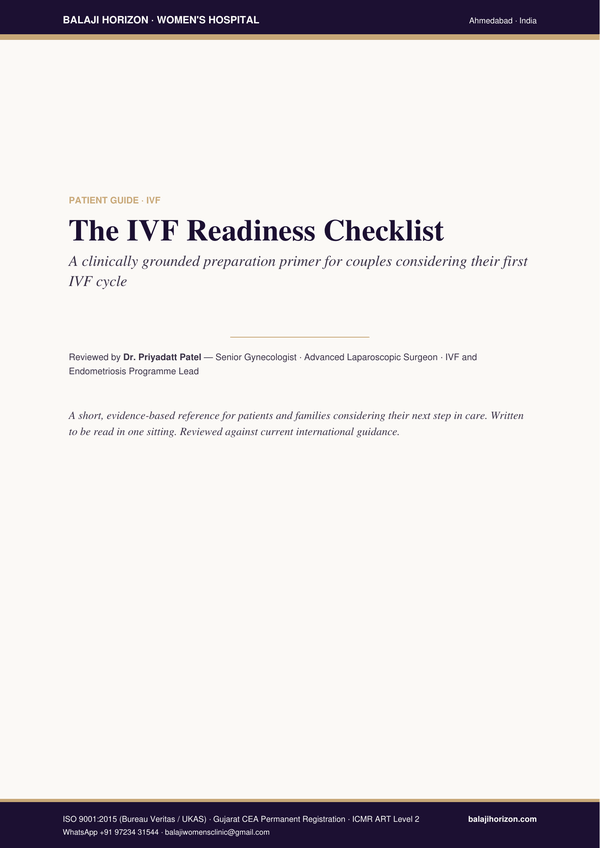
Free Patient Guide
A clinically grounded primer covering AMH ranges, the cycle in plain terms, ten questions to ask, and honest international live-birth reference data by age band.
Get the guide →Related: Been told your egg reserve is low? See our honest guide to IVF with low AMH in Ahmedabad — what the number really means.
Related: Deciding between treatments? See our honest guide to IUI vs IVF — which should come first.