
When a Second Opinion Before Surgery Is Worth Asking For
Being told you need surgery is a big moment. Whether it is a hysterectomy, fibroid removal or laparoscopy, it is reasonable — and often wise — to pause and ask for a second opinion before you decide. This is not about distrust; it is about making a confident, informed choice for your body and your future.
Why a second opinion is reasonable
Gynaecological surgery is rarely a single-option situation. Many conditions — fibroids, heavy bleeding, ovarian cysts, even endometriosis — can sometimes be managed with medication, monitoring, or a less extensive procedure. A second opinion simply confirms that the recommended operation is the right one, at the right time, for you.
When it is especially worth asking
Consider a second opinion if you have been advised a hysterectomy (uterus removal) for a benign condition; if surgery is suggested without a clear discussion of alternatives; if you still hope to preserve fertility; or if the plan does not account for your age, ovarian reserve or recurrence risk. Learn more about our minimal-access, uterus-preserving approach.
What a good second opinion looks like
A useful second opinion reviews your symptoms, imaging and history; explains why surgery is or is not indicated; lays out the alternatives honestly; and respects your priorities. It should leave you clearer, not more anxious.
In Ahmedabad
At Balaji Horizon Women’s Hospital (Science City Road), Dr. Priyadatt Patel offers fertility-aware, restraint-first second opinions — operating only when there is a clear indication. Send your reports for a second opinion before you decide.
FAQs
Is it rude to ask for a second opinion?
No. It is a normal, accepted part of good medical care, especially before major surgery.
Will it delay my treatment dangerously?
For benign gynaecological conditions, a brief pause for a considered second opinion is usually safe. Urgent situations are the exception.
Do I need to bring anything?
Your scans, reports and a summary of treatments tried so far help most.
Medical disclaimer: This article is for general education and is not a substitute for personal medical advice. Please consult a qualified specialist for evaluation tailored to you. Reviewed under the clinical authority of Dr. Priyadatt Patel.
Conditions where a second opinion most often changes the plan
Fibroids, heavy menstrual bleeding, ovarian cysts and endometriosis frequently have more than one reasonable path. A hysterectomy advised for fibroids, for example, can sometimes be replaced by a uterus-preserving myomectomy; heavy bleeding may respond to medical or minimally invasive treatment before surgery is considered.
What to bring
Bring your scans and reports, a list of treatments already tried, and your priorities — particularly whether you wish to preserve fertility. A clear history helps the second clinician give a focused, honest assessment.
Deciding with confidence
The goal is clarity, not conflict. Whether it confirms the original plan or offers an alternative, you move forward knowing you weighed your options carefully.

Free Patient Guide
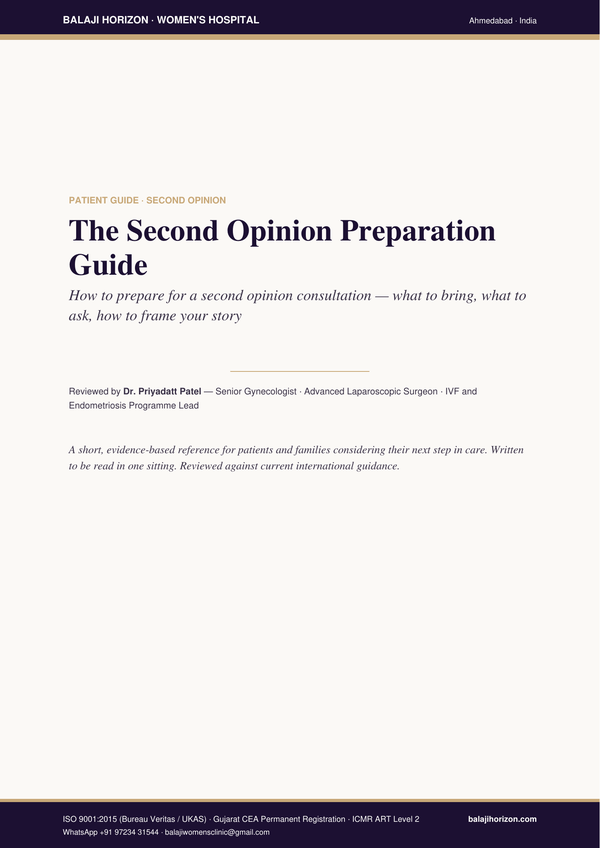
The Second Opinion Preparation Guide
When a second opinion is most useful, what to bring, how to frame your story, ten questions worth asking, and what to do after the opinion.
Get the guide →