
Endometriosis Specialist in Ahmedabad: What to Expect
Reading time: about 8 minutes. This article is educational and does not replace an individual consultation.
If you have lived with period pain that disrupts work, intimacy, or sleep — and been told repeatedly that it is “normal” — you are not imagining it, and you are not alone. Endometriosis affects roughly one in ten women of reproductive age, yet on average it is diagnosed years after symptoms first begin [Source: ESHRE Endometriosis Guideline, 2022]. This page explains what specialist endometriosis care actually involves, how a careful evaluation is structured, and what to expect if you choose to be assessed at Balaji Horizon Women’s Hospital in Ahmedabad.
Who this article is for
This is written for women in Ahmedabad and across Gujarat who have persistent pelvic pain, painful periods, pain during intercourse, cyclical bowel or bladder symptoms, or difficulty conceiving, and who want to understand what a structured specialist assessment looks like before booking an appointment.
What specialist endometriosis care really means
Endometriosis is a condition in which tissue similar to the lining of the uterus grows outside it — on the ovaries, the pelvic lining, and sometimes the bowel or bladder. It is best understood not simply as a disease of missing treatment, but as a disease of delayed diagnosis and unstructured decision-making. The quality of care depends less on how aggressively it is treated and more on how carefully it is mapped, planned, and matched to each woman’s priorities [Source: ESHRE Endometriosis Guideline, 2022]. Specialist care prioritises early clinical suspicion when symptoms fit, accurate mapping of where disease actually is, and an individualised plan that protects fertility and ovarian reserve rather than defaulting to repeated surgery.
Why early, structured evaluation matters
Endometriosis can affect fertility, and decisions about surgery, medical management, and assisted reproduction interact with each other — the right sequence depends on age, ovarian reserve, pain burden, and family-planning goals [Source: ESHRE Endometriosis Guideline, 2022]. Repeated ovarian surgery can reduce ovarian reserve, so a clear plan from the outset helps avoid unnecessary operations [Source: ASRM Committee Opinion on Endometriosis and Infertility, 2024]. A considered first assessment usually saves time, cost, and avoidable intervention later.
Symptoms that justify a specialist opinion
No single symptom confirms endometriosis, and symptoms vary widely. A specialist assessment is reasonable if you experience one or more of these in a persistent, cyclical pattern:
- Period pain severe enough to interrupt normal activity, or that no longer responds to simple painkillers
- Chronic pelvic pain lasting six months or more
- Pain during or after intercourse
- Cyclical bowel symptoms or bladder symptoms timed with periods
- Difficulty conceiving, particularly alongside any of the above
These point towards evaluation, not a confirmed diagnosis — the purpose of a specialist visit is to interpret them in context [Source: NICE Guideline NG73, Endometriosis: diagnosis and management].
How doctors evaluate endometriosis
- History. A detailed account of your symptoms, their cyclical pattern, their effect on daily life, and your fertility goals remains one of the most important diagnostic tools [Source: NICE Guideline NG73].
- Examination. A gentle clinical examination, where appropriate, to check for tenderness or nodularity.
- Expert pelvic ultrasound. A detailed transvaginal scan performed with endometriosis in mind can identify ovarian endometriomas and signs of deep disease; systematic ultrasound is a recognised first-line imaging approach [Source: ISUOG Consensus, IDEA approach].
- MRI mapping. Where deep disease involving bowel, bladder, or ureters is suspected, MRI helps map its extent and supports planning [Source: ESHRE Endometriosis Guideline, 2022].
- Fertility-related testing. If conception is a goal, ovarian reserve testing and, where relevant, a partner semen analysis inform the sequence of any treatment.
A normal scan does not rule out endometriosis — superficial disease may not be visible — which is why clinical interpretation matters more than any single test [Source: NICE Guideline NG73].
Treatment and management options
- Supportive and lifestyle measures. Pain-management strategies, pelvic-floor physiotherapy, and multidisciplinary support can meaningfully improve quality of life.
- Medical management. Hormonal options reduce pain for many women and are often a reasonable first step where fertility is not being actively pursued [Source: ESHRE Endometriosis Guideline, 2022]. They manage symptoms rather than removing disease.
- Surgical management. Laparoscopic surgery can treat disease and address pain or fertility in selected cases. The decision rests on symptom burden, disease location, fertility plans, and surgical risks — including the effect of ovarian surgery on reserve. Surgery is considered when genuinely indicated, not by default [Source: ESHRE Endometriosis Guideline, 2022].
- Fertility treatment. For some women, assisted reproduction such as IVF is more appropriate than surgery, or is combined with it in a planned sequence [Source: ASRM Committee Opinion, 2024].
- Monitoring and follow-up. As a long-term condition, ongoing review helps adjust the plan over time.
What to ask during your consultation
- How confident are we in the diagnosis, and what is uncertain?
- What are my options if fertility is — or is not — a current priority?
- If surgery is suggested, what is the specific indication, and what are the alternatives?
- How might surgery affect my ovarian reserve and future fertility?
- What is the plan if symptoms return after treatment?
- Who else (fertility, pain, colorectal, physiotherapy) might be involved in my care?
Endometriosis care in Ahmedabad: why local expert evaluation helps
Endometriosis is best managed where careful imaging, individualised planning, and access to both fertility and surgical expertise sit together, so decisions are coordinated rather than fragmented. For women in Ahmedabad and surrounding Gujarat, local assessment by a team that maps disease thoroughly and plans conservatively means fewer repeated journeys and a plan built around your goals. Balaji Horizon Women’s Hospital, on Science City Road, provides structured endometriosis evaluation alongside fertility and advanced laparoscopic care.
When to seek medical advice
Arrange a review if period pain interferes with normal life, if pelvic pain has persisted for six months or more, or if you are having difficulty conceiving. Seek urgent care for sudden severe pelvic pain, heavy bleeding with dizziness or fainting, or fever with pelvic pain [Source: NICE Guideline NG73].
A note on next steps
If persistent symptoms, an uncertain diagnosis, or fertility concerns are weighing on you, a structured consultation can clarify the safest next step. Balaji Horizon Women’s Hospital, Ahmedabad offers evidence-based endometriosis, fertility, and advanced laparoscopic care. Read more on our endometriosis programme, our approach to diagnosis, and treatment options.
Frequently asked questions
How is endometriosis diagnosed?
Diagnosis begins with a detailed symptom history and examination, supported by expert pelvic ultrasound and, where deep disease is suspected, MRI. Laparoscopy can confirm disease in selected cases but is no longer required to begin treatment. A normal scan does not exclude endometriosis, so clinical interpretation is essential [Source: NICE Guideline NG73; ESHRE, 2022].
Does endometriosis always need surgery?
No. Many women are managed effectively with medical and supportive treatment, and surgery is reserved for specific indications. Because repeated ovarian surgery can affect egg reserve, the decision is individualised rather than taken by default [Source: ESHRE Endometriosis Guideline, 2022].
Can I still get pregnant with endometriosis?
Many women with endometriosis conceive, with or without help. The impact on fertility varies, and options range from timed conception to assisted reproduction such as IVF. The best path depends on age, ovarian reserve, disease, and goals [Source: ASRM Committee Opinion, 2024].
Why did it take so long to get a diagnosis?
Symptoms overlap with other conditions and are often normalised, contributing to a well-documented diagnostic delay. Taking cyclical pain seriously earlier is one of the most effective ways to shorten that journey [Source: ESHRE Endometriosis Guideline, 2022].
What should I bring to my first appointment?
Bring a brief note of your symptom pattern and its effect on daily life, any previous scan or surgery reports, a list of treatments already tried, and your questions about fertility or pain.
Disclaimer: This article is for educational purposes only and does not replace a consultation with a qualified gynaecologist, fertility specialist, or treating doctor. Symptoms, fertility goals, ovarian reserve, imaging findings, and medical history must be individually assessed before deciding any treatment plan.

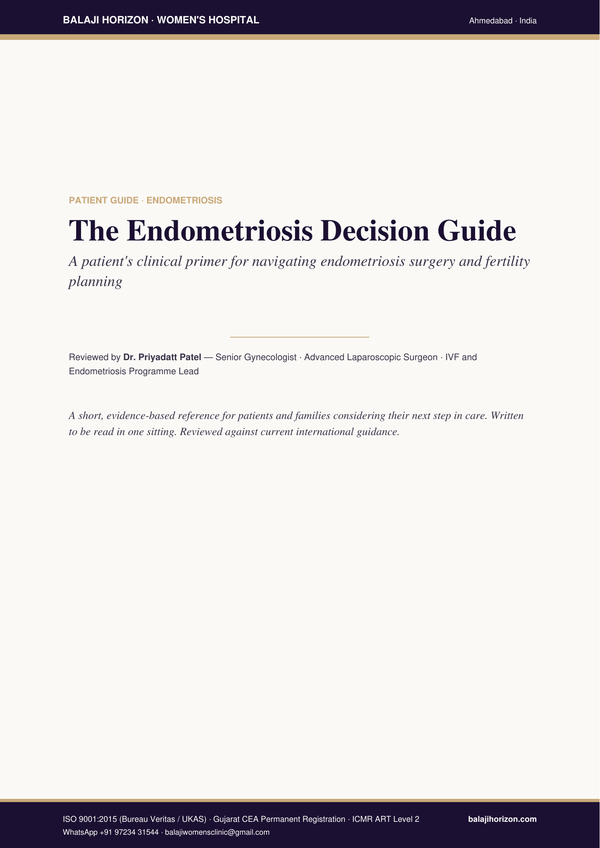
Free Patient Guide
The Endometriosis Decision Guide
A short clinical primer on diagnostic delay, the four decisions you may face, and what to bring to your specialist consultation. Aligned with ESHRE 2022, ASRM, FIGO guidance.
Get the guide →