
Fetal medicine · Cardiac screening
Fetal heart screening — anatomy scan, fetal echo, and when each is needed
In short
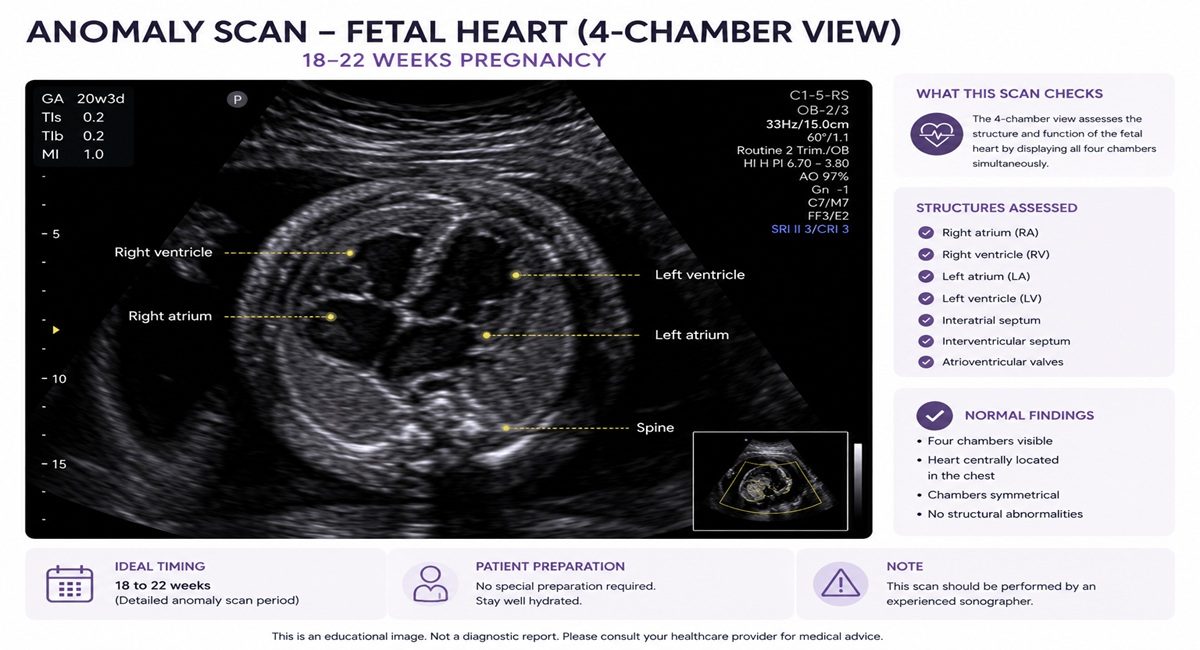
Fetal heart screening is part of the mid-trimester anomaly scan: the four-chamber view, the outflow tracts and the three-vessel view. It detects many but not all structural heart differences. A detailed fetal echocardiogram is a separate, more thorough study offered when there is a specific reason. Fetal sex is neither determined nor disclosed, as per the PC-PNDT Act.
Congenital heart disease (CHD) is the most common type of structural birth anomaly. Modern fetal cardiac screening detects most major lesions before birth, enabling planned delivery in a centre prepared for neonatal cardiac care. This page describes the standard cardiac views on the routine anomaly scan, the indications for dedicated fetal echocardiography, and how findings are communicated to the family.
Why fetal cardiac screening matters
Congenital heart disease occurs in approximately 8 per 1,000 live births. About one third are major lesions that benefit from prenatal diagnosis — the family can be counselled, the delivery can be planned in a centre with neonatal cardiology, the neonate can be transferred or stabilised at the moment of birth rather than after collapse. Detection before birth changes outcomes for these babies.
Standard cardiac views on the anomaly scan
The mid-trimester anomaly scan (18–22 weeks) should include the following ISUOG-recommended cardiac views in every pregnancy:
- Four-chamber view — size, symmetry, septum, atria, ventricles, valves
- Left ventricular outflow tract (LVOT)
- Right ventricular outflow tract (RVOT)
- Three-vessel view (3VV) — pulmonary artery, aorta, superior vena cava
- Three-vessel-trachea view (3VT) — assesses aortic arch orientation
- Situs (visceral and cardiac position)
- Cardiac rhythm and rate
These views, performed competently, detect the majority of major congenital heart disease. The anomaly scan is the screening tool; fetal echo is the diagnostic tool.
Indications for dedicated fetal echocardiography
- Maternal pre-existing diabetes or HbA1c above target in early pregnancy
- Maternal teratogen exposure (some anticonvulsants, ACE inhibitors, retinoids)
- Family history of congenital heart disease (first-degree relative)
- Suspected fetal cardiac abnormality on anomaly scan
- Increased nuchal translucency (≥3.5 mm) in first trimester
- Monochorionic twin pregnancy
- Fetal arrhythmia detected on routine examination
- Other major non-cardiac structural anomaly identified
- Confirmed fetal aneuploidy
- Pregnancy conceived by IVF or ICSI — selectively, particularly with other risk factors
- Maternal autoimmune disease with anti-Ro or anti-La antibodies
When fetal echo is performed
The preferred window for fetal echocardiography is 18–24 weeks. Late first-trimester / early second-trimester (14–16 weeks) fetal echo is feasible in selected indications (very-high-risk pregnancies, increased NT) but the structural detail is less than at 20–22 weeks. A repeat fetal echo in the third trimester may be performed where ductal-dependent or right-side lesions need confirmation closer to delivery.
What fetal echo can detect
- Most major septal defects (large VSDs, AVSDs)
- Hypoplastic left heart syndrome
- Transposition of the great arteries
- Tetralogy of Fallot
- Coarctation of the aorta (often suspected, sometimes confirmed only postnatally)
- Severe valvular abnormalities
- Major arrhythmias
- Ebstein anomaly
- Truncus arteriosus
What fetal echo cannot reliably detect
- Small ventricular septal defects (some close spontaneously)
- Atrial septal defects (the foramen ovale remains open in utero)
- Mild valvular disease
- Coarctation of the aorta in some cases (postnatal physiology unmasks it)
- Patent ductus arteriosus (physiological in utero)
- Some forms of total anomalous pulmonary venous return
A normal fetal echo therefore reduces but does not eliminate the chance of congenital heart disease at birth. The newborn cardiac examination remains important.
When a finding is identified
If a cardiac finding is identified prenatally, the conversation with the family covers: what is seen, the likely diagnosis (or differential), the natural history if untreated, the postnatal management plan, where delivery should happen, paediatric cardiology referral, the option of further testing including chromosomal/microarray, and what would change with progression in late pregnancy. Bereavement counselling is offered where lethal lesions are diagnosed and the couple is considering all their options.
Delivery planning for CHD
- Delivery in a centre with neonatal cardiology services
- Mode of delivery chosen by obstetric indication, not by the cardiac diagnosis alone
- Prostaglandin E1 immediately available where a ductal-dependent lesion is anticipated
- Echocardiography of the newborn within hours of birth
- Transfer to a paediatric cardiac centre when surgical or catheter intervention will be needed
When to refer for fetal echo
- Any of the indications listed above
- Suspected abnormality on routine anomaly scan
- Family request for cardiac reassurance in a higher-risk situation
- Pregnancy in a known carrier of an inherited cardiac syndrome
Guidelines we follow on this topic
- ISUOG Practice Guideline on Fetal Cardiac Screening
- AIUM Practice Guideline for Performance of Fetal Echocardiography
- American Heart Association statement on fetal echo indications
- RCOG good practice on fetal anomaly scan
Related reading
Fetal cardiac screening should include the four-chamber view and outflow tract views as a minimum. Specific risk groups (maternal diabetes, congenital heart disease in family, suspected anomaly) warrant detailed fetal echocardiography by a sub-specialist.
CONTINUE READING
Explore the Fetal Medicine Programme
Fetal Heart Screening is one element of the broader fetal medicine programme. The main fetal medicine pillar covers the complete pregnancy ultrasound schedule, anomaly screening, and Doppler protocols.
Your fetal-medicine specialist
Your fetal heart screening is performed by a clinician dedicated to fetal medicine, with a direct pathway to senior gynaecologist Dr. Priyadatt Patel for any pregnancy that needs obstetric care.

Dr. Mayank Chaudhary
An ISUOG-trained fetal-medicine consultant who performs detailed fetal cardiac screening, including the outflow tracts and rhythm.
Standards & further reading. Our approach aligns with the ISUOG guidelines and the NHS pregnancy ultrasound guide.
Related fetal-medicine pages
NT ScanAnomaly Scan (TIFFA)Doppler ScanNIPTPrenatal GeneticsAmniocentesisCVSCVS vs AmniocentesisFetal MedicinePregnancy Care
Fetal heart screening
This page explains who benefits from fetal heart assessment and how it fits the anomaly scan. For the detailed heart-imaging test itself, see fetal echocardiography.
Your fetal-medicine specialist
Fetal-medicine imaging at Balaji Horizon is led by Dr. Mayank Chaudhary, an ISUOG-trained fetal medicine specialist & sonologist — performing detailed anomaly (TIFFA) scanning, fetal echocardiography and high-risk pregnancy surveillance with the obstetric team. Meet the team →
Fetal heart screening — frequently asked questions
What is fetal heart screening?
How common are congenital heart defects?
What can raise the risk of a fetal heart problem?
Does a normal anomaly scan rule out heart disease?
What happens after screening?
Reviewed by Dr. Priyadatt Patel, MBBS, MS (Obstetrics & Gynaecology). This information is general education and not a substitute for a personal consultation.
Dr. Priyadatt Patel
Senior Gynecologist · Advanced Laparoscopic Surgeon · IVF and Endometriosis Programme Lead
MS OBGyn · Pregnancy Care · Advanced Gynaecological Ultrasound · Fertility Preservation
ESHRE / ESGE / AAGL / ASRM guideline-aligned practice. 3D Karl Storz precision technique. Fertility-preservation-first philosophy. Evidence-based decisions, honest counselling, long-term outcomes orientation.
Science City Road, Ahmedabad 380060
Mon–Sat 11:00–20:00 · +91 97234 31544
Naranpura, Ahmedabad
Mon–Sat 08:30–10:30 · +91 70460 02566