
Fetal medicine · Surveillance imaging
IUGR and Doppler studies — what the waveforms mean and when to deliver
In short
When a baby is measuring small, Doppler studies of the umbilical artery and the baby’s brain vessels help separate a constitutionally small baby from one whose growth is restricted. The pattern of blood flow, not the size alone, guides how closely the pregnancy is watched and when delivery is planned. Fetal sex is neither determined nor disclosed, as per the PC-PNDT Act.
Intra-uterine growth restriction (IUGR) is a pregnancy in which the fetus has not achieved its growth potential. Distinguishing constitutional small-for-gestational-age (SGA) from true placental insufficiency, and timing delivery correctly, requires structured Doppler surveillance. This page describes how Doppler studies are used at this centre — the vessels examined, what each waveform tells us, and the staged decision-making about delivery.
IUGR versus SGA
Two terms are used and they are not the same:
- SGA (small for gestational age) — estimated fetal weight (EFW) below the 10th centile for gestational age. A statistical definition. Many SGA babies are simply constitutionally small and healthy.
- IUGR (intra-uterine growth restriction) — failure of the fetus to reach its biological growth potential, usually due to placental insufficiency. Identified by EFW below the 3rd centile, OR EFW below the 10th centile with abnormal Doppler or growth velocity.
The Doppler studies are what separate the two clinically.
The Doppler vessels
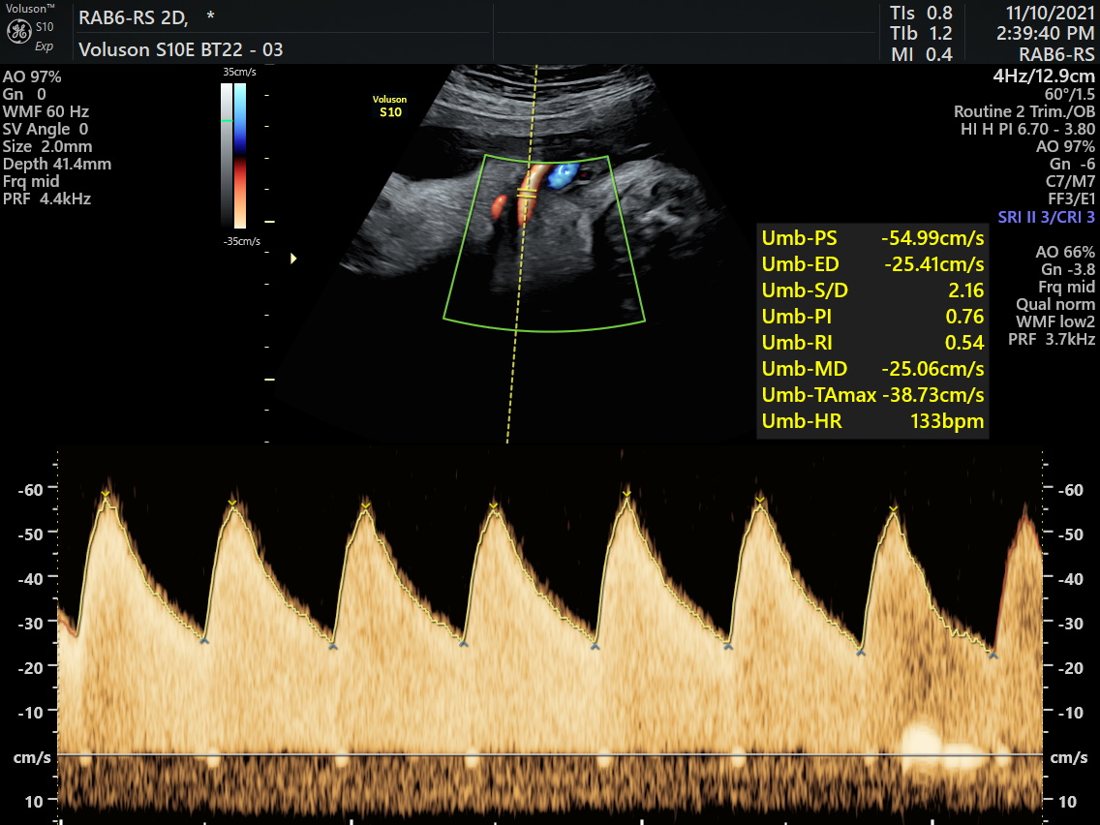
- Umbilical artery (UA) — reflects placental resistance. Earliest abnormal sign. Pulsatility index (PI) above the 95th centile, then absent end-diastolic flow (AEDF), then reversed end-diastolic flow (REDF) as deterioration progresses.
- Middle cerebral artery (MCA) — reflects fetal brain perfusion. PI below the 5th centile suggests fetal “brain-sparing” — a compensatory redistribution of blood to the brain in chronic hypoxia.
- Cerebroplacental ratio (CPR) — MCA PI divided by UA PI. CPR below the 5th centile is an integrated marker of fetal compromise.
- Ductus venosus (DV) — reflects right-heart afterload. Absent or reversed a-wave is a late, ominous sign indicating critical fetal compromise.
- Uterine artery — maternal placental flow. Used in early pregnancy for pre-eclampsia and IUGR risk prediction.
Staged interpretation
- Stage 1 (early FGR) — SGA + abnormal UA PI or CPR. Fortnightly surveillance.
- Stage 2 — UA AEDF. Weekly surveillance, steroids, plan delivery at 34 weeks.
- Stage 3 — UA REDF or DV-PI >95th centile. Bi-weekly surveillance, plan delivery at 30–32 weeks.
- Stage 4 — DV a-wave absent/reversed, abnormal cardiotocograph (CTG), or biophysical profile abnormality. Deliver at 26–30 weeks per balance of risks.
Delivery timing
Delivery is timed against three competing risks: fetal compromise if pregnancy continues, prematurity if delivery is too early, and the iatrogenic risks of intervention. ISUOG and the TRUFFLE trial findings inform the decision matrix. The trade-off is reassessed at each surveillance scan.
Mode of delivery
Mode of delivery is individualised. Vaginal birth is possible in early FGR where the fetus tolerates labour. Caesarean is preferred in advanced FGR with severe Doppler abnormality, AEDF/REDF, or non-reassuring CTG. Continuous intrapartum CTG monitoring is standard for any FGR pregnancy in labour.
After delivery
FGR babies need neonatal team involvement at birth. Long-term follow-up of growth, neurodevelopment, and cardiometabolic risk follows. The postnatal conversation with the couple includes the placental histology findings and the implications (if any) for subsequent pregnancies.
When to refer
- Any pregnancy where the growth scan suggests EFW below the 10th centile
- Any pregnancy with abnormal Doppler — even if EFW is normal
- Significant deceleration in growth velocity (centile crossing of more than 50 centiles between scans)
- Past pregnancy history with FGR or stillbirth
Guidelines we follow on this topic
- ISUOG Practice Guideline on Diagnosis and Management of Small-for-Gestational-Age Fetus and Fetal Growth Restriction
- RCOG Green-top on the Investigation and Management of the Small-for-Gestational-Age Fetus
- SMFM Consult Series on FGR
- TRUFFLE trial findings
Related reading
Umbilical artery Doppler is the cornerstone of fetal surveillance in suspected growth restriction. Progressive deterioration through middle cerebral artery, ductus venosus, and biophysical profile changes guides delivery timing.
CONTINUE READING
Explore the Fetal Medicine Programme
Doppler Studies in IUGR is one element of the broader fetal medicine programme. The main fetal medicine pillar covers the complete pregnancy ultrasound schedule, anomaly screening, and Doppler protocols.
Your fetal-medicine specialist
Growth-restricted pregnancies are monitored by a clinician dedicated to fetal medicine, with a direct pathway to senior gynaecologist Dr. Priyadatt Patel for any pregnancy that needs obstetric care.

Dr. Mayank Chaudhary
An ISUOG-trained fetal-medicine consultant who monitors growth-restricted babies with serial Doppler studies to guide the safest timing of delivery.
Standards & further reading. Our approach aligns with the ISUOG guidelines and the NHS pregnancy ultrasound guide.
Related fetal-medicine pages
NT ScanAnomaly Scan (TIFFA)Doppler ScanNIPTPrenatal GeneticsAmniocentesisCVSCVS vs AmniocentesisFetal MedicinePregnancy Care
Doppler in growth restriction
This page explains how Doppler is used in growth restriction (IUGR). For the Doppler scan itself and how it is performed, see Doppler studies, often arranged alongside a growth scan.
Doppler studies in growth restriction — frequently asked questions
What is a Doppler scan in pregnancy?
Why is Doppler important in growth restriction (IUGR)?
How often are Doppler scans repeated?
Is an abnormal Doppler always serious?
Does Doppler alone decide when the baby is delivered?
Reviewed by Dr. Priyadatt Patel, MBBS, MS (Obstetrics & Gynaecology). This information is general education and not a substitute for a personal consultation.
Dr. Priyadatt Patel
Senior Gynecologist · Advanced Laparoscopic Surgeon · IVF and Endometriosis Programme Lead
MS OBGyn · Pregnancy Care · Advanced Gynaecological Ultrasound · Fertility Preservation
ESHRE / ESGE / AAGL / ASRM guideline-aligned practice. 3D Karl Storz precision technique. Fertility-preservation-first philosophy. Evidence-based decisions, honest counselling, long-term outcomes orientation.
323, Satyamev Eminence, Beside Saptak Bungalows & AUDA Water Tank, Science City Road, Sola, Ahmedabad 380060
Open 24 hours (emergencies & labour) · OPD Mon–Sat 11:00–20:00 · +91 97234 31544
Naranpura, Ahmedabad
Mon–Sat 08:30–10:30 · +91 70460 02566